
MUNDO
VAISHNAVA

Templos de la India I
Creado por juancas del 12 de Junio del 2012
Templos de la India I

Imágenes de rukmini temple dwarka


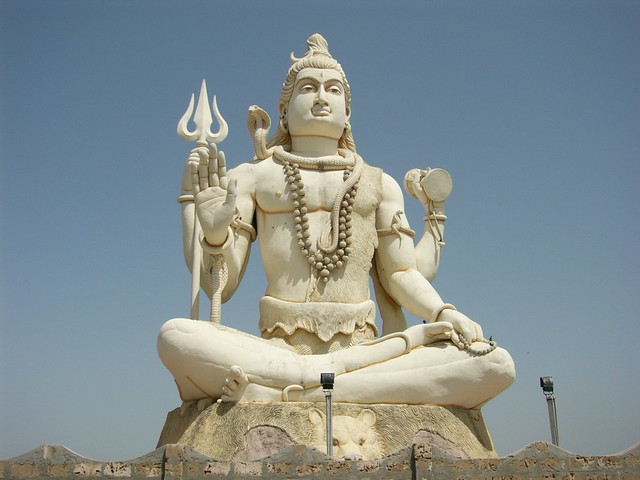
The Statue of Lord Shiva Shankar Mahadev at Shree Nageshwar Jyotirling Temple @ Dwarakvan, Gujrat, India.


In Hinduism, Khatushyamji is a name and manifestation of Barbarika, son of Ghatotkacha. This manifestation is especially popular in the Indian state of Rajasthan.
Barbarika had obtained a boon from Shree Krishna to the effect that he would be known by Krishna's own name (Shyam) in the Kaliyuga era and worshipped. Shree Krishna had declared that Barbarika's devotees would be blessed just by pronouncing his name from the bottom of their hearts. Their wishes would be granted and troubles removed if they worship Shyamji (Barbarika) with a true piety.
The legend begins with the Mahabharata. Barbarika alias Khatushyamji was a grandson of Bhima, Second of the Pandava brothers. He was the son of Ghatotkacha, son of Bhima, by his wife Ahilawati. Even in his childhood, Barbarika was very brave warrior. He learnt the art of warfare from his mother. God Shiva, pleased with him, gave him the three infallible arrows (Teen Baan). Hence, Barbarika came to be known by the appellation Teen Baandhaari, the "Bearer of Three Arrows". Later, Agni (the god of Fire) gave him the bow that would make him victorious in the three worlds.
When Barbarika learnt that battle between the Pandavas and the Kauravas had become inevitable, he wanted to witness what was to be the Mahabharata War. He promised his mother that if he felt the urge to participate in the battle, he would join the side which would be losing. He rode to the field on his Blue Horse equipped with his three arrows and bow.
Shree Krishna disguised as a Brahmin and stopped Barbarika to examine his strength. He baited Barbarika by mocking him for going to the great battle with only three arrows. On this, Barbarika replied that a single arrow was enough to destroy all his opponents in the war, and it would then return to his quiver. He stated that, the first arrow is used to mark all the things that he wants to destroy. On releasing the third arrow, it would destroy all the things that are marked and will then return to his quiver. If he uses the second arrow, then the second arrow will mark all the things that he wants to save. On using the third arrow, it will destroy all the things that are not marked.
Shree Krishna then challenges him to tie all the leaves of the peepal tree under which he was standing with these arrows. Barbarika accepts the challenge and starts meditating to release his arrow by closing his eyes. Then, Krishna without the knowledge of Barbarika, plucks one of the leaf of the tree and puts it under his foot. When Barbarik releases his first arrow, it marks all the leaves of the tree and finally starts revolving around the leg of Krishna. For this Krishna asks Barbarika, as why was the arrow revolving around his foot? For this, Barbareek replies that there must be a leaf under his foot and the arrow was targeting his foot to mark the leaf that is hidden under him. Barbarika advises Krishna to lift his leg, since, otherwise the arrow will mark the leaf by pricking Krishna's leg.
Thus, Krishna lifts his foot and to his surprise, finds that the first arrow also marks the leaf that was hidden under his foot. Of course, the third arrow does collect all the leaves (including the one under Krishna's foot) and ties them together. By this Krishna concludes that the arrows are so infallible, that even if Barbarika is not aware of his targets, the arrows are so powerful that they can still navigate and trace all his intended targets. The moral of this incident is that, in a real battle field, if Krishna wants to isolate some one to avoid them from being Barbarika's victim, then Krishna will not be successful as the arrows can still trace the target and destroy them. Thus Krishna gets a deeper insight about Barbarika's phenomenal power.
Krishna then asks the boy whom he would favour in the war. Barbarika reveals that he intends to fight for the side whichever is weak. As Pandavas have only seven Akshouni army, when compared to Kauravas eleven, he considers that Pandavas are weak and hence wants to support them so that Pandavas will become victrious. But Krishna asks him, did he seriously give a thought before giving a word to his mother (to support the weak side). Barbarika guesses that his support to the weaker side will make them victrious. Then, Krishna reveals the actual consequence of his word to his mother:
Shree Krishna tells that whichever side he supports will only make the other side weak due to his power. Hence, he is forced to change the side that has become weaker due to his word to his mother. Thus, in an actual war, he will keep oscillating between the two sides, there by destroying the entire army of both sides and eventually only he remains. Subsequently, none of the side is victorious as he will be the only lone survivor. Hence, Krishna avoids his participation from the war by seeking his head in Charity.
The guised Krishna then sought charity from Babarika. Barbarika promised him anything he wished. Krishna asked him to give his head in charity. Barbarika was shocked. Perceiving that all was not as it appeared, he requested the Brahmin to disclose his real identity. Shree Krishna showed Barbarika a vision of His Divine Form and Barbarika was thus graced. Krishna then explained to him that before a battle, the head of the bravest Kshatriya needs to be sacrificed, in order to worship/sanctify the battlefield. Krishna said that he considered Barbarika to be the bravest among Kshatriyas, and was hence asking for his head in charity. In fulfilment of his promise, and in compliance with the Krishna's command, Barbarika gave his head to him in charity. This happened on the 12th day of the Shukla Paksha (bright half) of the month of Mangsir.
Before decapitating himself, Barbarika told Krishna of his great desire to view the forthcoming battle, and requested him to facilitate it. Krishna agreed, and placed the head atop a hill overlooking the battlefield. From the hill, the head of Barbarika watched the whole battle.
At the end of the battle, the victorious Pandava brothers argued amongst themselves as to who was responsible for the victory. Krishna suggested that Barbarika's head, which had watched the whole battle, should be allowed to judge. Barbarika's head suggested that it was Krishna alone who was responsible for the victory: his advice, his presence, his gameplan had been crucial. Barbarika's head said that he had seen the Sudarshana Chakra revolving around the battlefield, hacking the Kaurava army to pieces; and Draupadi, assuming the fearful form of Mahakali Durga, drinking bowl after bowl of blood without allowing even one drop of blood to fall on the earth.
!! Jai Jai Shree Khatu Shayam Ji !!i
Huge Shiva Statue near Nageshwara Mahadev Temple
Next to the Nageshwara Mahadev temple in Dwarka, there was this huge shiva statue. Probably it was built by Gulshan Kumar (not confirmed though)
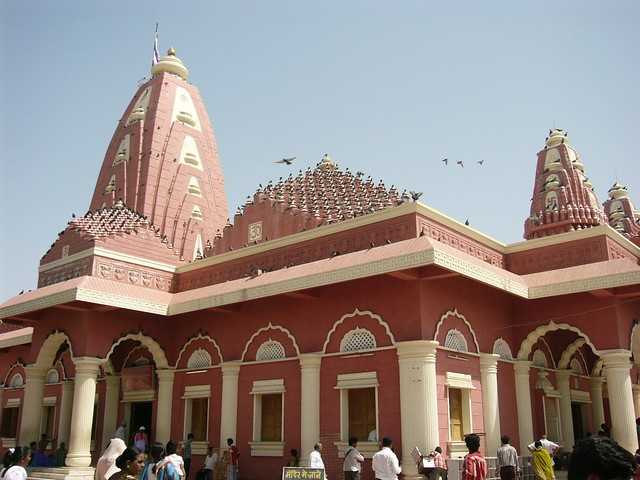
Nageshwar Mahadev Temple
The temple in Dwarka is one of the 12 Jyotirlaingas of Shiva in India.
Shree Shree Rukmani Devi Temple nearby Shree Dham Dwarka, Gujrat, India
The Rukmani Devi temple, positioned 1.5 Kms to the Shri Dham Dwarkapuri, is an architectural masterwork. Rukmini Devi Temple in Dwarka is devoted to Rukmini, the most important amongst Krishna's 16,108 wives.
There is a story behind this temple. One day, Durvasa Muni, who was easily angered, was invited to dinner by Krishna and his wife, Rukmini. Etiquette dictates that when a person is invited to dinner, the host should refrain from eating until the guest has been satisfied. However, while Durvasa was eating, Rukmini became thirsty. She asked Krishna to help her. Krishna, to bail out his wife, put his foot in the ground. As a result, the Ganges waters streamed forth from the ground while Durvasa was not looking. As luck would have it, while Rukmini was drinking the water, Durvasa turned that way and saw her drinking without seeking his permission. This made him angry. He cursed her to live apart from Lord Krishna. That is the reason why Krishna's temple is in the city and hers is positioned outside the city.
There is a story behind this temple. One day, Durvasa Muni, who was easily angered, was invited to dinner by Krishna and his wife, Rukmini. Etiquette dictates that when a person is invited to dinner, the host should refrain from eating until the guest has been satisfied. However, while Durvasa was eating, Rukmini became thirsty. She asked Krishna to help her. Krishna, to bail out his wife, put his foot in the ground. As a result, the Ganges waters streamed forth from the ground while Durvasa was not looking. As luck would have it, while Rukmini was drinking the water, Durvasa turned that way and saw her drinking without seeking his permission. This made him angry. He cursed her to live apart from Lord Krishna. That is the reason why Krishna's temple is in the city and hers is positioned outside the city.
The Temple of Shree Shyam Jee @ Khatushyamji, Rajasthan, India
Galería de abhishekpandey
In Hinduism, Khatushyamji is a name and manifestation of Barbarika, son of Ghatotkacha. This manifestation is especially popular in the Indian state of Rajasthan.
Barbarika had obtained a boon from Shree Krishna to the effect that he would be known by Krishna's own name (Shyam) in the Kaliyuga era and worshipped. Shree Krishna had declared that Barbarika's devotees would be blessed just by pronouncing his name from the bottom of their hearts. Their wishes would be granted and troubles removed if they worship Shyamji (Barbarika) with a true piety.
The legend begins with the Mahabharata. Barbarika alias Khatushyamji was a grandson of Bhima, Second of the Pandava brothers. He was the son of Ghatotkacha, son of Bhima, by his wife Ahilawati. Even in his childhood, Barbarika was very brave warrior. He learnt the art of warfare from his mother. God Shiva, pleased with him, gave him the three infallible arrows (Teen Baan). Hence, Barbarika came to be known by the appellation Teen Baandhaari, the "Bearer of Three Arrows". Later, Agni (the god of Fire) gave him the bow that would make him victorious in the three worlds.
When Barbarika learnt that battle between the Pandavas and the Kauravas had become inevitable, he wanted to witness what was to be the Mahabharata War. He promised his mother that if he felt the urge to participate in the battle, he would join the side which would be losing. He rode to the field on his Blue Horse equipped with his three arrows and bow.
Shree Krishna disguised as a Brahmin and stopped Barbarika to examine his strength. He baited Barbarika by mocking him for going to the great battle with only three arrows. On this, Barbarika replied that a single arrow was enough to destroy all his opponents in the war, and it would then return to his quiver. He stated that, the first arrow is used to mark all the things that he wants to destroy. On releasing the third arrow, it would destroy all the things that are marked and will then return to his quiver. If he uses the second arrow, then the second arrow will mark all the things that he wants to save. On using the third arrow, it will destroy all the things that are not marked.
Shree Krishna then challenges him to tie all the leaves of the peepal tree under which he was standing with these arrows. Barbarika accepts the challenge and starts meditating to release his arrow by closing his eyes. Then, Krishna without the knowledge of Barbarika, plucks one of the leaf of the tree and puts it under his foot. When Barbarik releases his first arrow, it marks all the leaves of the tree and finally starts revolving around the leg of Krishna. For this Krishna asks Barbarika, as why was the arrow revolving around his foot? For this, Barbareek replies that there must be a leaf under his foot and the arrow was targeting his foot to mark the leaf that is hidden under him. Barbarika advises Krishna to lift his leg, since, otherwise the arrow will mark the leaf by pricking Krishna's leg.
Thus, Krishna lifts his foot and to his surprise, finds that the first arrow also marks the leaf that was hidden under his foot. Of course, the third arrow does collect all the leaves (including the one under Krishna's foot) and ties them together. By this Krishna concludes that the arrows are so infallible, that even if Barbarika is not aware of his targets, the arrows are so powerful that they can still navigate and trace all his intended targets. The moral of this incident is that, in a real battle field, if Krishna wants to isolate some one to avoid them from being Barbarika's victim, then Krishna will not be successful as the arrows can still trace the target and destroy them. Thus Krishna gets a deeper insight about Barbarika's phenomenal power.
Krishna then asks the boy whom he would favour in the war. Barbarika reveals that he intends to fight for the side whichever is weak. As Pandavas have only seven Akshouni army, when compared to Kauravas eleven, he considers that Pandavas are weak and hence wants to support them so that Pandavas will become victrious. But Krishna asks him, did he seriously give a thought before giving a word to his mother (to support the weak side). Barbarika guesses that his support to the weaker side will make them victrious. Then, Krishna reveals the actual consequence of his word to his mother:
Shree Krishna tells that whichever side he supports will only make the other side weak due to his power. Hence, he is forced to change the side that has become weaker due to his word to his mother. Thus, in an actual war, he will keep oscillating between the two sides, there by destroying the entire army of both sides and eventually only he remains. Subsequently, none of the side is victorious as he will be the only lone survivor. Hence, Krishna avoids his participation from the war by seeking his head in Charity.
The guised Krishna then sought charity from Babarika. Barbarika promised him anything he wished. Krishna asked him to give his head in charity. Barbarika was shocked. Perceiving that all was not as it appeared, he requested the Brahmin to disclose his real identity. Shree Krishna showed Barbarika a vision of His Divine Form and Barbarika was thus graced. Krishna then explained to him that before a battle, the head of the bravest Kshatriya needs to be sacrificed, in order to worship/sanctify the battlefield. Krishna said that he considered Barbarika to be the bravest among Kshatriyas, and was hence asking for his head in charity. In fulfilment of his promise, and in compliance with the Krishna's command, Barbarika gave his head to him in charity. This happened on the 12th day of the Shukla Paksha (bright half) of the month of Mangsir.
Before decapitating himself, Barbarika told Krishna of his great desire to view the forthcoming battle, and requested him to facilitate it. Krishna agreed, and placed the head atop a hill overlooking the battlefield. From the hill, the head of Barbarika watched the whole battle.
At the end of the battle, the victorious Pandava brothers argued amongst themselves as to who was responsible for the victory. Krishna suggested that Barbarika's head, which had watched the whole battle, should be allowed to judge. Barbarika's head suggested that it was Krishna alone who was responsible for the victory: his advice, his presence, his gameplan had been crucial. Barbarika's head said that he had seen the Sudarshana Chakra revolving around the battlefield, hacking the Kaurava army to pieces; and Draupadi, assuming the fearful form of Mahakali Durga, drinking bowl after bowl of blood without allowing even one drop of blood to fall on the earth.
!! Jai Jai Shree Khatu Shayam Ji !!i

Shree Shree Nageshwar Jyotirling Temple @ Dwarkavan( Nearby Dwarka), Gujrat, India
Shree Nageshwar near Dwarka in Gujarat is one of the 12 Jyotirlinga Shrines of Shiva Shankar. Lord Krishna Himself used to worship it and perform Rudrabhishekam. It is located on the route between Dwarka and the Beyt Dwarka island, on the coast of Saurashtra in Gujarat. The Rudra Samhita sloka refers to Nageshwar with the phrase 'Daarukaavane Naagesham'.
Pandavas came here during their Vanavas to build a hermitage for themselves. Their cows used to go to the same river bank to drink water. After drinking water, milk used to flow automatically into the river as if the cows were offering to the river. One day Bhima saw this miraculous event and told Dharmaraja about the same. Then Dharmaraja said, “Surely, some great God must be living in this river”. Then the Pandavas started removing the water from the river. The middle part of the river was so hot that the water there was boiling. Bheema lifted his mace and attacked the river thrice. The water gave way instantly. Lord Shankara’s Linga could be seen as the Jyotirlinga.
Legend has it that a devotee by name Supriya, was attacked by a demon Daaruka, while in a boat and that the demon imprisoned him along with several others at his capital Daarukaavana, where he resided with his wife Daaruki. Shiva appeared in the form of a Jyotirlingam and vanquished the demon with the Paasupata Astram.
Pandavas came here during their Vanavas to build a hermitage for themselves. Their cows used to go to the same river bank to drink water. After drinking water, milk used to flow automatically into the river as if the cows were offering to the river. One day Bhima saw this miraculous event and told Dharmaraja about the same. Then Dharmaraja said, “Surely, some great God must be living in this river”. Then the Pandavas started removing the water from the river. The middle part of the river was so hot that the water there was boiling. Bheema lifted his mace and attacked the river thrice. The water gave way instantly. Lord Shankara’s Linga could be seen as the Jyotirlinga.
Legend has it that a devotee by name Supriya, was attacked by a demon Daaruka, while in a boat and that the demon imprisoned him along with several others at his capital Daarukaavana, where he resided with his wife Daaruki. Shiva appeared in the form of a Jyotirlingam and vanquished the demon with the Paasupata Astram.
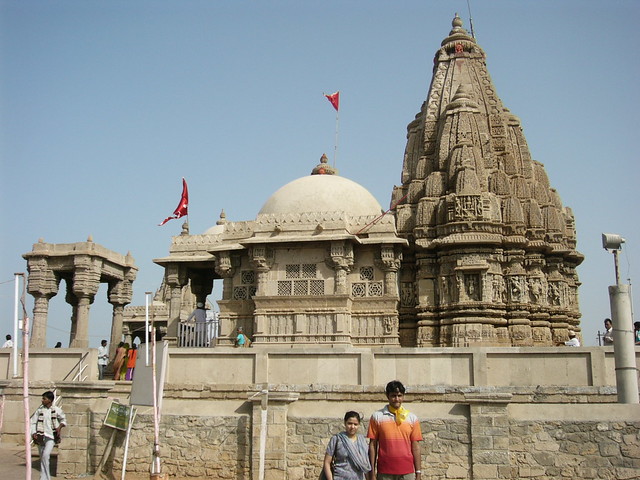
Temple of Rukmini Devi - Dwarka
Shraddha and Sunil in the foreground
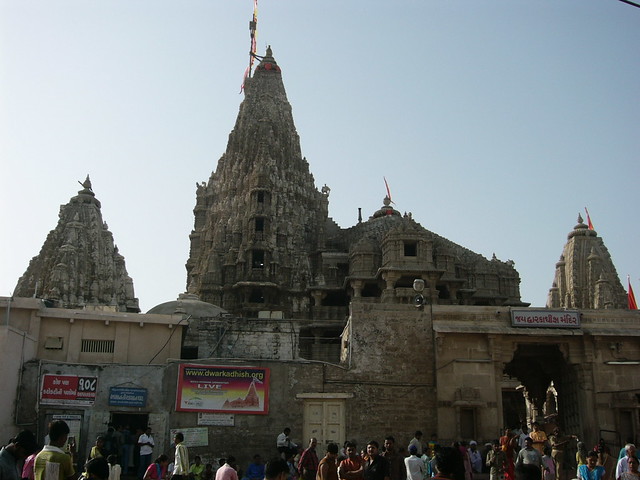
The main Dwarka temple - Dwarkadhish temple
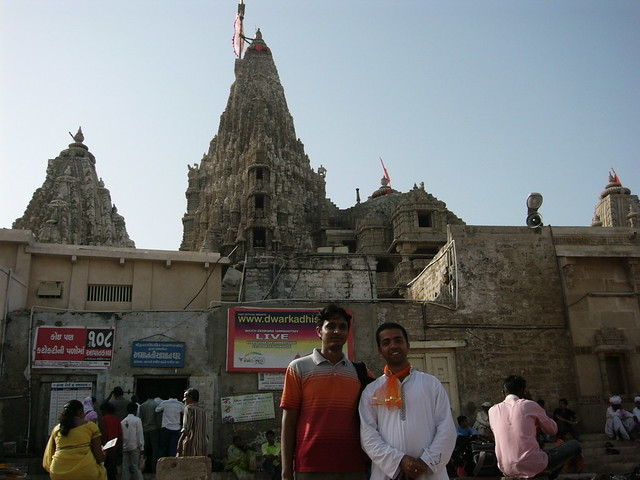
The main Dwarka temple - Dwarkadhish temple
Sunil and I. I am wearing a scarf like thing which I got as a prasad from the temple.
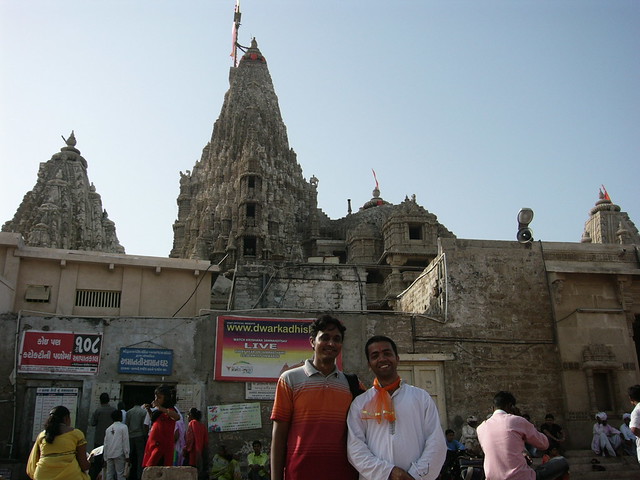
The main Dwarka temple - Dwarkadhish temple
Sunil and I
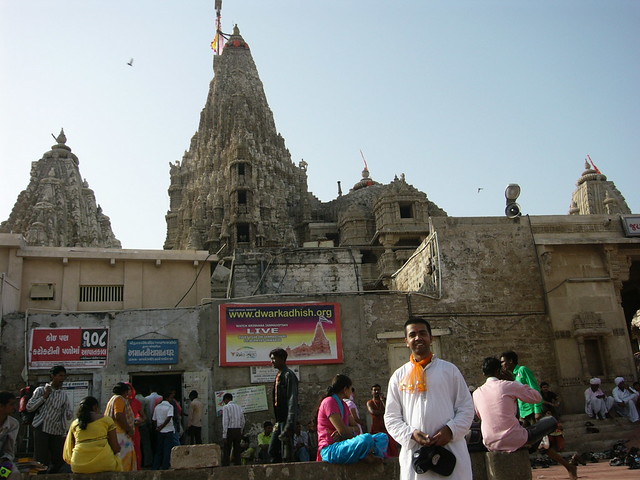
The main Dwarka temple - Dwarkadhish temple
Shree Shree Dwarkadhish Temple @ Dwarka, Gujrat, India
The City of Dwaraka is best known as the home of Lord Dwarkadisa, who resides in His Jagad Mandir. The Dwarkadish Temple describes how Sri Krisna became Dwarkadish in this way:
"Jarasandha, father-in-law of Kansa, attacked Matura on seventeen different occasions and on each occasion under the leadership of Shri Krishna, the people of Mathura bravely repulsed the attack. Krishna realized that the real strength of Jarasandha was his reliance on Hans and Dhimak, who were on Jarasandha's side. So with a great deal of foresight, Shri Krishna cleverly got Hansa and Dhimak killed. This was the policy of war.
Shri Krishna had to fight the large majority of people who were materialistic and evil-minded. Jarasandha was frightened after the death of Hansa and Dhimak, and his army lost confidence.
Jarasandha, with great effort, once again built up his army and invaded Mathura for the 18th time. On this occasion Vikadru, a member of the Yadav assembly spoke the bitter truth, saying 'Krishna, we have limitless love for you. We cannot compensate for your obligations on us. Yet these invasions are because of you. The civic life of Mathura is completely disrupted. Commerce and trade have been ruined. The people are not able to attend to agricultural duties and as a result the progress is hindered. And on the top of all, the danger of one more invasion of Jarasandha is hanging over Mathura. Hence in these circumstances, for the good of the people I request you to leave us. It is bitter but it is the truth. Please consider, Shri Krishna your followers are not sentimental. They cannot remain sentimental because of your teaching. Therefore, I as your devotee tell you the truth without fear.'
The entire assembly was stunned and silent. Shri Krishna's father, Vasudev, supported Vikrendu in assembly. Shri Krishna realized that the republic had to face many dangers because of him, and He decided to leave Mathura. Thus He proved that He not only advised, but also lived accordingly.
He advised the Yadavas,' I have taught you true culture. Live according to the ideals and impart these teachings to others. I will leave Matura and go to Dwarka, in Saurashtra.'
Thereafter Shri Krishna crossed Gomantak (Girnar Mountain) went to Saurashtra, where he built Dwarka City (the City of Gold) at a distance of 20 miles from Prabhas Patan (today's Veraval Somanath). Shri Krishna appeared to have settled in Dwarka, though his mind was engaged in re-establishing a kingdom based on the principal of true religion. And he made Dwarka, the empire which is based on the principal of true religion, called Dharma Rajya in true sense. Here he become known as the ruler of Dwarka, Shri Dwarkadhish."
* The Dwaja of Shree Dwarkadhish jee Temple has been changed each day and it will be given to "Maali" of the Temple
"Jarasandha, father-in-law of Kansa, attacked Matura on seventeen different occasions and on each occasion under the leadership of Shri Krishna, the people of Mathura bravely repulsed the attack. Krishna realized that the real strength of Jarasandha was his reliance on Hans and Dhimak, who were on Jarasandha's side. So with a great deal of foresight, Shri Krishna cleverly got Hansa and Dhimak killed. This was the policy of war.
Shri Krishna had to fight the large majority of people who were materialistic and evil-minded. Jarasandha was frightened after the death of Hansa and Dhimak, and his army lost confidence.
Jarasandha, with great effort, once again built up his army and invaded Mathura for the 18th time. On this occasion Vikadru, a member of the Yadav assembly spoke the bitter truth, saying 'Krishna, we have limitless love for you. We cannot compensate for your obligations on us. Yet these invasions are because of you. The civic life of Mathura is completely disrupted. Commerce and trade have been ruined. The people are not able to attend to agricultural duties and as a result the progress is hindered. And on the top of all, the danger of one more invasion of Jarasandha is hanging over Mathura. Hence in these circumstances, for the good of the people I request you to leave us. It is bitter but it is the truth. Please consider, Shri Krishna your followers are not sentimental. They cannot remain sentimental because of your teaching. Therefore, I as your devotee tell you the truth without fear.'
The entire assembly was stunned and silent. Shri Krishna's father, Vasudev, supported Vikrendu in assembly. Shri Krishna realized that the republic had to face many dangers because of him, and He decided to leave Mathura. Thus He proved that He not only advised, but also lived accordingly.
He advised the Yadavas,' I have taught you true culture. Live according to the ideals and impart these teachings to others. I will leave Matura and go to Dwarka, in Saurashtra.'
Thereafter Shri Krishna crossed Gomantak (Girnar Mountain) went to Saurashtra, where he built Dwarka City (the City of Gold) at a distance of 20 miles from Prabhas Patan (today's Veraval Somanath). Shri Krishna appeared to have settled in Dwarka, though his mind was engaged in re-establishing a kingdom based on the principal of true religion. And he made Dwarka, the empire which is based on the principal of true religion, called Dharma Rajya in true sense. Here he become known as the ruler of Dwarka, Shri Dwarkadhish."
* The Dwaja of Shree Dwarkadhish jee Temple has been changed each day and it will be given to "Maali" of the Temple
"Prayers by the Demigods for Lord Krishna in the Womb Lord Brahmâ , Siva, Nârada, Indra, Chandra and Varuna, invisibly approached the room of Mother Devakî, where they all joined in offering their respectful prayers to please the Supreme Godhead.
They prayed: “O Lord, You never deviate from your vow, which is always perfect because whatever you decide is perfectly correct and cannot be stopped by anyone. you are the Supreme Truth. Indeed, unless one is completely truthful, one cannot achieve your favor. You are the active principle, the real truth, in all the ingredients of creation, and therefore you are known as antaryâmî, the inner force. You are the beginning of all truth. Therefore, offering our obeisances, we surrender unto you. Kindly give us protection. "
Then they said to Devki : “O mother Devakî, by your good fortune and ours, the Supreme Personality of Godhead Himself is now within your womb. Therefore you need not fear Kamsa. yur eternal son, Krishna , will be the protector of the entire Yadu dynasty."
After thus offering prayers they returned to their homes in the heavenly planets.""
"Prayers by the Demigods for Lord Krishna in the Womb Lord Brahmâ , Siva, Nârada, Indra, Chandra and Varuna, invisibly approached the room of Mother Devakî, where they all joined in offering their respectful prayers to please the Supreme Godhead. They prayed: “O Lord, You never deviate from your vow, which is always per...fect because whatever you decide is perfectly correct and cannot be stopped by anyone. you are the Supreme Truth. Indeed, unless one is completely truthful, one cannot achieve your favor. You are the active principle, the real truth, in all the ingredients of creation, and therefore you are known as antaryâmî, the inner force. You are the beginning of all truth. Therefore, offering our obeisances, we surrender unto you. Kindly give us protection. " Then they said to Devki : “O mother Devakî, by your good fortune and ours, the Supreme Personality of Godhead Himself is now within your womb. Therefore you need not fear Kamsa. yur eternal son, Krishna , will be the protector of the entire Yadu dynasty." After thus offering prayers they returned to their homes in the heavenly planets.""
"Thereafter, at the auspicious time for the appearance of the Lord, the entire universe was surcharged with all the qualities of goodness, beauty and peace. The constellation Rohinî appeared, as did stars like Asvinî. The sun, the moon and the other stars and planets were very peaceful. All directions appeared extremely pleasing, and the beautiful stars twinkled in the cloudless sky. The rivers flowed with clear water, In the trees and green plants, full of flowers and leaves, pleasing to the eyes, Bees began chanting with sweet voices. Vasudeva and Devaki saw the newborn child, who had very wonderful lotuslike eyes and who bore in His four hands the four weapons s'ankha, cakra, gadâ and padma. On His chest was the mark of S'rîvatsa and on His neck the Kaustubha gem. Dressed in yellow, His scattered hair fully grown, His helmet and earrings sparkling with the valuable gem, the child, decorated with a brilliant belt, armlets appeared very wonderful. When Vasudeva and Devki Ji saw his son, his eyes were struck with wonder."
"Sometimes Mother Yasoda and Gopis tell Krishna, "O Kanha! Bring this article" or "Bring that article." Sometimes they order him to bring a wooden plank or wooden measuring pot, and Krishna, when ordered by the mothers, would try to bring them.
Once Mother Yasoda asked him to bring his father wooden shoe, n immediately Krishna brings Nanda Baba’s shoes upon his head. And sometimes, however, as if unable to raise these things, He would touch them n stand there. Just to invite the pleasure of his relatives, He would strike his body with his arms to show that he had sufficient strength.
As time passed, Krishna increased the pleasure of the Vrajavasis by his childhood activities. Gopies would say to him - "O Krishna, If You dance, then I’ll give you half a sweetmeat." By saying these words, all gopies encouraged Krishna in different ways. At such times, He would smile n dance according to their desire, as if He were a doll in their hands. Sometimes He sings loudly at their bidding. In tis way, Krishn came completely under the control of the gopies."
"Shree Radhe-Shri Krishna.....One Supersoul resides in two bodies.......
दोनों है, दोनों के नैनो के तारे, नमामि राधे नमामि कृष्णा ! ये सृस्ठी सारी यही पुकारे, नमामि राधे नमामि कृष्णा !!"
"ओ श्याम........ ओ मेरे श्याम......
जब याद मोहन की आती है, एक अजब नज़ारा होता है ! आँखों से आँसू होते है, दिल दर्द का मारा रोता है !!
तेरा प्यार छिपा कर सीने में, उस पार तड़पता रहता हूँ ! ओ श्याम........ ओ मेरे श्याम......
जी चाहता है आकर मिलु, पर दूर किनारा होता है !!
जब याद तेरी आ जाती है, बह जाता हूँ तूफानों में ! मझदार में गोते खाकर भी, एक तेरा सहारा होता है !!
जब याद मोहन की आती है, एक अजब नज़ारा होता है ! ओ श्याम........ओ मेरे श्याम......
आँखों से आँसू होते है, दिल दर्द का मारा रोता है !!"
"आहा! रे............आहा! रे...........
आहा! रे देखो रे ये नन्द का छोरा....
कितना सुन्दर, कितना प्यारा....
ठेर कदम्ब की छाया में ठाडो, यशुमति के नैनन का तारा.......
ओ..ऐसी बाँसुरी बजावे....
ऐसी बाँसुरी बजावे, बरस परे रसधारा.....
ब्रज ब्रज की एक एक गोपी ने, इस पे अपना तन, मन वारा........
आहा! रे देखो रे ये नन्द का छोरा....
कितना सुन्दर, कितना प्यारा......"
"मोहे तो भरोसो है, तिहारो री किशोरी राधे.........
!! श्री राधा मेरी स्वामिनी, मैं राधाजी को दास !! !! जनम जनम मोहे दीजियो, श्री वृन्दावन को वास !!"
"गिरिराज धरण मैं... हूँ तुम्हारी शरण... गिरिराज धरण मैं... हूँ तुम्हारी शरण... तुम्हारी शरण प्रभु....
तुम्हारी शरण..... गिरिराज धरण मैं....
हूँ तुम्हारी शरण... गिरिराज धरण मैं... हूँ तुम्हारी शरण... गिरिराज धरण मैं... हूँ तुम्हारी शरण..."
"Shri Shri Caitanya Mahaprabhu and His associate Shri Shri Nityananda Ji brought the chanting of "Hare Krishna Hare Krishna Krishna Krishna Hare Hare, Hare Rama Hare Rama, Rama Rama Hare Hare." to this world. They are likened to the sun and the moon, and they have arisen simultaneously to dissipate the darkness of ignorance and thus wonderfully bestow benedictions upon all.. Jai Jai Shree Krishna......Jai Jai Shree Radha......."
"The Supreme Personality of Godhead Shri Krishna is surrounded by Mansukha, Sridama, Madhumangla, and the other gopa and His beloved cows. Shri Krishna enjoys pastimes on the bank of Shri Yamuna Ji.
Hearing the sound of Krishna’s flute, the cows and all his friends nearby become filled with bliss and the demigods in the celestial worlds become filled with wonder. Shri Krishna has become glorious like the moon. With the sound of His flute He made the cows stunned with bliss.
Who will not be blessed and happy to see Shri Krishna slowly walking behind His cows, showering them with nectarean flute songs, His restless locks of hair turned grey by the dust thrown up by their hooves???"
"!! श्री कृष्ण शरणम ममः !!
दीन दुःखियों का, निर्बल जनों का सदा, दृढ सहारा है श्री कृष्ण शरणम ममः। वैष्णवों का हितैषी, सदन शांति का, प्राण प्यारा है श्री कृष्ण शरणम ममः। काटने के लिये मोह जंजाल को, तेज तलवार श्री कृष्ण शरणम ममः। नाम ही मंत्र है मंत्र ही नाम है, है महामंत्र श्री कृष्ण शरणम ममः। छूट जाते है साधन सभी अंत में, साथ रहता है श्री कृष्ण शरणम ममः। साथी दुनिया में कोई किसी का नही, सच्चा साथी है श्री कृष्ण शरणम ममः। चाहे मानो न मानो खुशी आपकी, सच्चा धन तो है, श्री कृष्ण शरणम ममः। डर नही है किसी द्वेत का, प्रेत का , शुद्धद्वैत श्री कृष्ण शरणम ममः। श्याम सुंदर निकुंजों में मिल जायेगें, ढूंढ लायेगा श्री कृष्ण शरणम ममः। दुनिया सपना है अपना न कोई यहाँ , नित्य जपना है श्री कृष्ण शरणम ममः। आप उनके बनें वे बने आपके, यही कहता है श्री कृष्ण शरणम ममः। भक्त सोता है तब भी स्वयं जाग कर, पहरा देता है श्री कृष्ण शरणम ममः।
!! श्री कृष्ण शरणम ममः। श्री कृष्ण शरणम ममः। !!"
"!! ॐ नमो भगवते वासुदेवाय !! श्रीमन नारायण नारायण हरि हरि... श्रीमन नारायण नारायण हरि हरि... तेरी लीला सबसे न्यारी न्यारी.....हरि हरि... तेरी महिमा प्रभु है प्यारी प्यारी...हरि हरि
श्रीमन नारायण नारायण हरि हरि..... श्रीमन नारायण नारायण हरि हरि....."
"!! ॐ नमो भगवते वासुदेवाय !! Ajamila was a resident of Kanyakubja (the modern Kanauj). He was trained by his parents to become a perfect brahmana by studying the Vedas and following the regulative principles, but because of his past, this youthful brahmana was somehow attracted by a prostitute, and because of her association he became most fallen and abandoned all regulative principles.
Ajamila begot in the womb of the prostitute ten sons, the last of whom was called Narayan. At the time of Ajamila's death, when the order carriers of Yamaraja came to take him, he loudly called the name “Narayan” “Narayan” in fear because he was attached to his youngest son. Thus he remembered the original Narayan, Lord Vishnu. Although he did not chant the holy name of Narayan completely offenselessly, it acted nevertheless.
As soon as he chanted the holy name of Narayan, the Lord Shri Hari Vishnu immediately appeared on the scene. A discussion ensued between the Lord Shri Hari Vishnu and those carriers of Yamaraja, and by hearing that discussion Ajamila was liberated. He could then understand the bad effect of fruitive activities and could also understand how exalted is the process of devotional service.
Shrimad Bhagwat Mahapuraan (6.1)"
"भगवती श्री तुलसी जी से जुड़ी एक कथा बहुत प्रचलित है। श्रीमद देवि भागवत पुराण में इनके अवतरण की दिव्य लीला कथा भी बनाई गई है। एक बार शिव ने अपने तेज को समुद्र में फैंक दिया था। उससे एक महातेजस्वी बालक ने जन्म लिया। यह बालक आगे चलकर जालंधर के नाम से पराक्रमी दैत्य राजा बना। इसकी राजधानी का नाम जालंधर नगरी था। दैत्यराज कालनेमी की कन्या वृंदा का विवाह जालंधर से हुआ। जालंधर महाराक्षस था। अपनी सत्ता के मद में चूर उसने माता लक्ष्मी को पाने की कामना से युद्ध किया, परंतु समुद्र से ही उत्पन्न होने के कारण माता लक्ष्मी ने उसे अपने भाई के रूप में स्वीकार किया। वहां से पराजित होकर वह देवि पार्वती को पाने की लालसा से कैलाश पर्वत पर गया।भगवान देवाधिदेव शिव का ही रूप धर कर माता पार्वती के समीप गया, परंतु मां ने अपने योगबल से उसे तुरंत पहचान लिया तथा वहां से अंतध्यान हो गईं। देवि पार्वती ने क्रुद्ध होकर सारा वृतांत भगवान विष्णु को सुनाया। जालंधर की पत्नी वृंदा अत्यन्त पतिव्रता स्त्री थी। उसी के पतिव्रत धर्म की शक्ति से जालंधर न तो मारा जाता था और न ही पराजित होता था। इसीलिए जालंधर का नाश करने के लिए वृंदा के पतिव्रत धर्म को भंग करना बहुत ज़रूरी था।इसी कारण भगवान विष्णु ऋषि का वेश धारण कर वन में जा पहुंचे, जहां वृंदा अकेली भ्रमण कर रही थीं। भगवान के साथ दो मायावी राक्षस भी थे, जिन्हें देखकर वृंदा भयभीत हो गईं। ऋषि ने वृंदा के सामने पल में दोनों को भस्म कर दिया। उनकी शक्ति देखकर वृंदा ने कैलाश पर्वत पर महादेव के साथ युद्ध कर रहे अपने पति जालंधर के बारे में पूछा। ऋषि ने अपने माया जाल से दो वानर प्रकट किए। एक वानर के हाथ में जालंधर का सिर था तथा दूसरे के हाथ में धड़। अपने पति की यह दशा देखकर वृंदा मूर्चिछत हो कर गिर पड़ीं। होश में आने पर उन्होंने ऋषि रूपी भगवान से विनती की कि वह उसके पति को जीवित करें।भगवान ने अपनी माया से पुन: जालंधर का सिर धड़ से जोड़ दिया, परंतु स्वयं भी वह उसी शरीर में प्रवेश कर गए। वृंदा को इस छल का ज़रा आभास न हुआ। जालंधर बने भगवान के साथ वृंदा पतिव्रता का व्यवहार करने लगी, जिससे उसका सतीत्व भंग हो गया। ऐसा होते ही वृंदा का पति जालंधर युद्ध में हार गया। इस सारी लीला का जब वृंदा को पता चला, तो उसने क्रुद्ध होकर भगवान विष्णु को शिला होने का श्राप दे दिया तथा स्वयं सति हो गईं। जहां वृंदा भस्म हुईं, वहां तुलसी का पौधा उगा। भगवान विष्णु ने वृंदा से कहा, ‘हे वृंदा। तुम अपने सतीत्व के कारण मुझे लक्ष्मी से भी अधिक प्रिय हो गई हो। अब तुम तुलसी के रूप में सदा मेरे साथ रहोगी। जो मनुष्य भी मेरे शालिग्राम रूप के साथ तुलसी का विवाह करेगा उसे इस लोक और परलोक में विपुल यश प्राप्त होगा।’ जिस घर में तुलसी होती हैं, वहां यम के दूत भी असमय नहीं जा सकते। गंगा व नर्मदा के जल में स्नान तथा तुलसी का पूजन बराबर माना जाता है। चाहे मनुष्य कितना भी पापी क्यों न हो, मृत्यु के समय जिसके प्राण मंजरी रहित तुलसी और गंगा जल मुख में रखकर निकल जाते हैं, वह पापों से मुक्त होकर वैकुंठ धाम को प्राप्त होता है। जो मनुष्य तुलसी व आवलों की छाया में अपने पितरों का श्राद्ध करता है, उसके पितर मोक्ष को प्राप्त हो जाते हैं।"
"!! ॐ नमो भगवते वासुदेवाय !!
मैं कहता डंके की चोट पर, ध्यान से सुनियो लाला..... अपना हरि है हज़ार हाथ वाला. ओ दीनदयाला......
अपना हरि है, हज़ार हाथ वाला.....
ओ दीनदयाला....
अपना हरि है, हज़ार हाथ वाला........
कोई झुका नहीं सकता जग में, अपने प्रभु का झंडा...अपने प्रभु का झंडा..... जो उसको छेरेगा....
उसके सर पे परेगा डंडा......उसके सर पे परेगा डंडा....
युगों युगों से इस धरती पर......उसी का है बोल बाला......
अपना हरि है, हज़ार हाथ वाला.....
ओ दीनदयाला....
अपना हरि है, हज़ार हाथ वाला.......
मैं कहता डंके की चोट पर, ध्यान से सुनियो लाला..... अपना हरि है हज़ार हाथ वाला. ओ दीनदयाला......
अपना हरि है, हज़ार हाथ वाला.....
ओ दीनदयाला....
अपना हरि है, हज़ार हाथ वाला.......
!! जय जय नारायण नारायण हरि हरि !!"
"Shri Krishna- Shri Balrama"
"!! श्री मधुराष्टकं !!
अधरं मधुरं वदनं मधुरं, नयनं मधुरं हसितं मधुरं। हृदयं मधुरं गमनं मधुरं, मधुराधिपते रखिलं मधुरं ॥१॥
O Krishna....Sweet are Your lips, Sweet is Your face, Sweet are Your eyes, Sweet is Your smile, Sweet is Your heart, Sweet is Your gait, O Lord of all Sweetness in this world , everything about You is Sweet.
वचनं मधुरं चरितं मधुरं, वसनं मधुरं वलितं मधुरं । चलितं मधुरं भ्रमितं मधुरं, मधुराधिपते रखिलं मधुरं ॥२॥
O Krishna...Sweet are Your words, Sweet is Your story, Sweet are Your garments, Sweet is Your presence, Sweet are Your movements, Sweet are Your roamings,O Lord of all Sweetness in this world, everything about You is Sweet.
वेणुर्मधुरो रेनुर्मधुरः, पाणिर्मधुरः पादौ मधुरौ । नृत्यं मधुरं सख्यं मधुरं, मधुराधिपते रखिलं मधुरं ॥३॥
O Krishna....Sweet is Your flute, Sweet is the dust of Your feet, Sweet are Your hands, Sweet are Your feet, Sweet is Your dance, Sweet is Your friendship, O Lord of all Sweetness in this world, everything about You is Sweet.
गीतं मधुरं पीतं मधुरं, भुक्तं मधुरं सुप्तं मधुरं । रूपं मधुरं तिलकं मधुरं, मधुराधिपते रखिलं मधुरं ॥४॥
Sweet is Your song, what is drunk by You is Sweet, what is eaten by You is Sweet, and Sweet is Your sleep, Sweet is Your form, Sweet is the mark on Your forehead, O Lord of all Sweetness in this world , everything about You is Sweet.
करणं मधुरं तरणं मधुरं, हरणं मधुरं रमणं मधुरं । वमितं मधुरं शमितं मधुरं, मधुराधिपते रखिलं मधुरं ॥५॥
O Krishna......Sweet are Your works, Sweet is Your conquest, Sweet is Your theft, Sweet is Your remembrance, Sweet are Your offerings, Sweet is Your cure,O Lord of all Sweetness in this world, everything about You is Sweet.
गुंजा मधुरा माला मधुरा, यमुना मधुरा वीचीर्मधुरा । सलिलं मधुरं कमलं मधुरं, मधुराधिपते रखिलं मधुरं ॥६॥
O Krishna.....Sweet is Your murmuring, Sweet is Your garland, Sweet is the Yamuna River, Sweet are the waves, Sweet is the water, Sweet is the lotus flower, O Lord of all Sweetness in this world, everything about You is Sweet.
गोपी मधुरा लीला मधुरा, युक्तं मधुरं मुक्तं मधुरं। दृष्टं मधुरं सृष्टं मधुरं, मधुराधिपते रखिलं मधुरं ॥७॥
O Krishna....Sweet are the Gopis, Sweet is Your divine sporting, Sweet is Your union, sweet are Your experiences, What You behold is Sweet, Sweet are Your left overs, O Lord of all Sweetness in this world, everything about You is Sweet.
गोपा मधुरा गावो मधुरा, यष्टिर्मधुरा सृष्टिर्मधुरा । दलितं मधुरं फ़लितं मधुरं, मधुराधिपते रखिलं मधुरं ॥८॥
O Krishna......Sweet are the Gopas, Sweet are the cows, Sweet are the pearls around Your neck, Sweet is Your creation, Sweet are Your victories, Sweet are Your jokes, O Lord of all Sweetness in this world, everything about You is Sweet.
हरे कृष्णा...... हरे कृष्णा........
Hare Krishna...Hare Krishna....."
"हमारे श्याम श्यामा .........
अनुपम माधुरी जोड़ी, हमारे श्याम श्यामा की.....
रसीली मदभरी अँखिया, हमारे श्याम श्यामा की....
मुकुट ओ चन्द्रिका माथे , अधर पे पान की लाली.....
अहो! कैसी भली छवि है, हमारे श्याम श्यामा की.....
परस्पर मिलके जब विहरे, ये वृन्दावन के कुंजो में....
नहीं वरणत बने शोभा, हमारे श्याम श्यामा की...
नहीं कुछ लालसा धन की, नहीं निर्वाण की इच्छा...
वेह मुझको दे दर्शन, दया हो श्याम श्यामा की....
अनुपम माधुरी जोड़ी, हमारे श्याम श्यामा की.....
रसीली मदभरी अँखिया, हमारे श्याम श्यामा की...."
"श्री गाँधारी का श्राप और प्रभु श्री कृष्ण का श्राप स्वीकारना..
दुर्योधन के अंत के साथ ही महाभारत के महायुद्ध का भी अंत हो गया ।
माता गाँधारी दुर्योधन के शव के पास खडी फफक-फफक कर रो रही हैं। पुत्र वियोग में “गाँधारी का भगवान कृष्ण को श्राप देना, भगवान कृष्ण का श्राप को स्वीकार करना और गाँधारी का पश्चताप करना” ।
इसका बडा ही मार्मिक वर्णन निम्नलिखित पंक्तियों में किया है।
(गीता-कविता से संकलित)
श्री गाँधारी : ह्र्दय विदारक स्वर में "तो वह पडा है कंकाल मेरे पुत्र का किया है यह सब कुछ कृष्ण तुमने किया है सब सुनो आज तुम भी सुनो मैं तपस्विनी गाँधारी अपने सारे जीवन के पुण्यों का बल ले कर कहती हूँ कृष्ण सुनो तुम अगर चाहते तो रूक सकता था युद्द यह मैंने प्रसव नहीं किया था कंकाल वह इंगित पर तुम्हारे ही भीम ने अधर्म किया क्यों नहीं तुमने यह शाप दिया भीम को जो तुमने दिया अश्वत्थामा को तुमने किया है प्रभुता का दुरूपयोग यदि मेरी सेवा में बल है संचित तप में धर्म है प्रभु हो या परात्पर हो कुछ भी हो सारा तुम्हारा वंश इसी तरह पागल कुत्तों की तरह एक दूसरे को परस्पर फाड खायेगा तुम खुद उनका विनाश कर के कई वर्षों बाद किसी घने जंगल में साधारण व्याध के हाथों मारे जाओगे प्रभु हो पर मारे जाओगे पशु की तरह"
श्री कृष्ण ध्वनि: "प्रभु हूँ या परात्पर पर पुत्र हूँ तुम्हारा तुम माता हो मैंने अर्जुन से कहा सारे तुम्हारे कर्मों का पाप पुण्य योगक्षेम मैं वहन करूँगा अपने कंधों पर अट्ठारह दिनों के इस भीषण संग्राम में कोई नहीं केवल मैं ही मरा हूँ करोडों बार जितनी बार जो भी सैनिक भूमिशायी हुआ कोई नहीं था मैं ही था गिरता था जो घायल हो कर रणभूमि में अश्वत्थामा के अंगों से रक्त पीप स्वेद बन कर बहूँगा मैं ही युग युगांतर तक जीवन हूँ मैं तो मृत्यु भी मैं ही हूँ माँ श्राप यह तुम्हारा स्वीकार है" श्री गाँधारी: "यह क्या किया तुमने फूट कर रोने लगती है कोई नहीं में अपने सौ पुत्रों के लिये लेकिन कृष्ण तुम पर मेरी ममता अगाध है कर देते श्राप मेरा तुम अस्वीकार तो क्या मुझे दु:ख होता? मैं थी निराश मैं कटु थी पुत्रहीन थी" श्री कृष्ण ध्वनि: "ऐसा मत कहो माता जब तक मैं जीवित हूँ पुत्रहीन नहीं हो तुम प्रभु हूँ या परात्पर पर पुत्र हूँ तुम्हारा तुम माता हो"
हरे कृष्णा..... हरे कृष्णा....."
""मेरी तो मेरे श्याम से यही एक अरदास है कि..."
कुछ दे या न दे श्याम, इस अपने दीवाने को....
दो आँसू तो दे दे, चरणों में बहाने को........
नरसी ने बहाए थे, मीरा ने बहाए थे.....
जब जब भी कोई रोया, तुम दौर के आये थे....
काफी है दो बुँदे, घनश्याम रिझाने को...
दो आँसू तो दे दे, चरणों में बहाने को.....
आँसू वो ख़जाना है, किस्मत से मिलता है.....
इनके बह जाने से मेरा श्याम, पिघलता है.......
करुणा का तू सागर है, अब छोर बहाने को.....
दो आंसू तो दे दे, चरणों में बहाने को.....
दुःख में बह जाते है, खुशियों में जरुरी है.....
आँसू के बिना भाई, हर आँख अधूरी है......
पूरा करते आँसू, हर एक हर्जाने को....
दो आंसू तो दे दे, चरणों में बहाने को.....
कुछ दे या न दे श्याम, इस अपने दीवाने को....
दो आँसू तो दे दे, चरणों में बहाने को........"
"!! श्री द्वारकाधीश जी मंदिर !!
" The Temple of Shree Dwarkadhish Jee @ Dwarka, Gujrat, India ""
"!! जय जय श्री द्वारकाधीश जी !!
" Shree Shree Dwarkadhish Jee ""
"!! जय जय श्री किशोरी राधे !!
तीनो लोकों से न्यारी, ओ राधा रानी हमारी....
तीनो लोकों से न्यारी, ओ राधा रानी हमारी......
राधा रानी हमारी, ओ राधा रानी हमारी.....
राधा रानी हमारी, ओ राधा रानी हमारी.....
तीनो लोकों से न्यारी, ओ राधा रानी हमारी....
सनकादिक तेरो यश गावे, ब्रह्मा विष्णु तेरी आरती उतारे....
ओ देखो इन्द्र लगावे बुहारी, ओ राधा रानी हमारी....
सर्वेश्वरी जगत कल्याणी, ब्रज की मालिक राधारानी....
यहाँ कोई न रहता भिखारी, ओ राधारानी हमारी.....
तीनो लोकों से न्यारी, ओ राधा रानी हमारी....
राधा रानी हमारी, ओ राधा रानी हमारी.....
एक बार जो बोले राधा, कट जाये जीवन की बाधा....
ओ कृपा करो महारानी, ओ राधा रानी हमारी......
तीनो लोकों से न्यारी, ओ राधा रानी हमारी....
राधा रानी हमारी, ओ राधा रानी हमारी.......
राधा रानी हमारी, ओ राधा रानी हमारी.....
राधा रानी हमारी, ओ राधा रानी हमारी.....
तीनो लोकों से न्यारी, ओ राधा रानी हमारी...."
"O Krishna....O Krishna....
हे! कृष्णा... हे! कृष्णा...
“O Krishna...O Krishna.... Son of Vasudeva, O All-pervading Personality of Godhead, I offer my respectful obeisance unto You. I meditate upon You because You are the Absolute Truth and the primeval cause of all causes of the creation, sustenance and destruction of the manifested universes." "O Krishna....O Krishna...... I know, You are now with me, yet I am unable to see you. Grant me Grace, empower me to behold You. You are my Light. You are my Father. You are my eternal Mother. You are the Breath of my breath. You are everything. From all sides, at all times, You are watching me, seeing me, blessing me. You are in the children, in the creatures great andsmall. You are everywhere. Why don’t You reveal Yourself to me?" "O Krishna.....O Krishna....Lead me, guide me, purify me, render me peaceful, wise, strong, noble, saintly. As You are in me, express Yourself through me. Let me be a channel for the flow of Your Nature and Qualities. Not my personality, but Your Personality which is full of Perfection, finds Its expression through me. I don’t want my will to be done, for my will is imperfect, exposed to wrong impulse, full of limitations. Thy Will is wonderful, perfect, omnipotent. Let Thy Will be done through me." "O Krishna...O Krishna....My intelligence makes many mistakes. What it thinks to be the right thing is often to be not so. Let Thy Intelligence which is omniscient guide my intelligence along the right and fruitful lines. My heart is limited in its love; sometimes I love people who are beneficial to me, and cease loving them when they no more serve my interests. Let Thy Love which is unconditioned rule my heart. My best plans to protect my interests are not free from unforeseen difficulties. Anything can easily burden me with cares and worries. Let Thy Wisdom, Thy Light, Thy Care, Thy Grace, conduct my life and preserve me in the experience of Thy Peace, Thy Power, Thy Happiness." O Krishna....O Krishna....
हे! कृष्णा... हे! कृष्णा..."
"श्री कृष्णा कृष्णा कृष्णा..... श्री राधे राधे राधे.......
श्री राधे कृष्ण की ज्योत अलौकिक, तीनो लोक में छाए रह्यो है.....
भक्ति विवश तेरो प्रेम पुजारी, फिर भी दीप जलाए रह्यो है.......
कृष्णा को गोकुल से राधे को, बरसाने से बुलाये रह्यो है....
दोनों करो स्वीकार कृपा कर, तेरो दास आरती गाए रह्यो है.......
श्री राधे कृष्ण की ज्योत अलौकिक, तीनो लोक में छाए रह्यो है.....
भक्ति विवश तेरो प्रेम पुजारी, फिर भी दीप जलाए रह्यो है.......
भोर भये ते सांझ ढले तक, सेवा को नित नेम हमारो.....
स्नान करायेब, वस्त्र उढ़ायेब, भोग लगायेब लागत प्यारो......
कब ते निहारत आप की ओर, कि आप भी हमरी ओर निहारो....
राधे कृष्ण हमारे धाम को, जानि वृन्दावन धाम पधारो......
श्री राधे कृष्ण की ज्योत अलौकिक, तीनो लोक में छाए रह्यो है.....
भक्ति विवश तेरो प्रेम पुजारी, फिर भी दीप जलाए रह्यो है......."
"!! Mahra Kamalnayan Keshav Jee !!
Kamalnayan Keshav Suno, Mahre Dil Ri Baat. Main Ati Deen Anaath Hu, Aap Ho Naath Sanaath...
Daata Aapre Dwar Par, Aa Gayo Deen Anaath. Sunni Pardsi Keshav Tane, Is Dardi Ki Baat...
Yaadan Karta Aapki,Dukhan Lagya Nain. Gadd Vani Mahri Hui Gayi, Nikse Naahi Vain... Mujhe To Bus Chahey,Teri Charana Ri Dhur. Thari Bhakti Prem Se, Munn Hove Bharpur... Thari Maduri Si Muskaan Par, Hu Daata Kurbaan. Jaadugari Thari Bansari, Badi Anothi Shaan...
"Jai Shree Kamalnayan Keshav Thari""
"Once a woman selling fruit in Gokul was calling, "O inhabitants of Gokula, if you want to purchase some fresh fruits, come here!"
After hearing that Our Little Kanhaiya come nearer to her and asked : “O Ma, O Ma, Are these fruits sweet ?
She replied : “Yes Lalla, these are sweet…"
She asked : "Want to Have some…??”
Kanhaiya Said : ‘Yes..”
She asked : “How many?”
Kanhaiya asked : “How many will you give me?”
She replied : “As per the price you give..”
Kanhaiya asked : “Price??? What is price??”
She asked : ”You do not Understad Price?”
Kanhaiya said : “No”
She said : “How Innocent you are! Lalla, when you take something from someone, then you have to give something, that is called Money..”
Kanhaiya asked : “Money? What is it? I don’t have any…”
She replied : “You will not know. Get it from you mother.”
Kanhaiya replied : “My mother has gone to Yamuna for take bathe..”
She asked : “Is there any grain in home?“
Kanhaiya replied : “Yes, Plenty…”
She said : “Ok, Go, get some….That’ll do”
Kanhiya asked : “O Ma, How strange, My mother gives me so many things, but takes no price, Milk maids give me butter, but take no price….Yes..They want me to cuddle them and call them ‘mother’! “
Kanhaiya continued : “If I sit in your lap calling you ‘mother’ can I get fruit?”
She replied : “How innocent you are! Even if I wish I cannot have you in my lap..”
Kanhaiya asked : “Why?”
She replied : “Because I am untouchable. How may I fondle you?
Then suddenly Little Kanhiya sat on her lap and hugs her and said : “Like this, Ma ….”
She said : “Oh, What have you done, Lalla? If someone see- what havoc! “ Kanhaiya asked : “Why? Untochables aren’t human? , I don’t accept such barriers..”
He agian said : “My freidns are low-castes, you too are like my mother”
Then the fruit seller woman eyes filled with tears of love and affection for the son of Nand Maharaja and Said : “Lalla , you are a magician…your touch has spread light in the depths of my soul….”
She continued : “I won’t get a better price than this.. Take whatever you want….”
Kanhaiya said : “I want all these..”
She said : “All?....All right..”
Kanhaiya Said : “Don’t worry Ma, I’ll give you a lot of grain too..”
She replied : “I don’t want it, Lalla! You have given enough…”
Then Kanhaiya immediately gone inside the house to take some grains, While Krishna was going to the her very hastily, most of the grains He was holding fell.
Kanhaiya : “Ma, I brought so much grain for you…”
She sees Kanhaiya with love and said : “Oh Lalla! It is a lot of grain…..”
Kanhaiya said : “Ma, I brought a handful it spilled, only this is left “
She replied : “This is more than enough, It will fill my basket”
She Said : “Lalla..It is a very good bargain…..Here, take your fruits…”
Nonetheless, She filled Kanhaiya's hands with fruits, and her fruit basket was immediately filled with jewels and gold…..
Her eyes were filled with tears of love and affection………..
हीरे मोती दान में दे, भक्ति की भी राह दिखाए न्यारी...
सुब कुछ देकर परीक्षा लेता, की कौन-सी ओर चले संसारी..
He showers jewels, and shows a new path of devotion, Giving all he takes a test which way we all go…
ऐसे मोह के जाल बिछाये, कि फँस के रह जाये बुद्धि बिचारी...
सोच समझकर सौदा कीजो, ये नन्द को लाल बरो व्यापारी...
In his snare of temptation, intellect is entrapped…. Think well and make a deal, Son of Nand Maharaja is so Shrewd…
!! जय हो कन्हैया लाल की !!"
"ओ आजा कलयुग में भी लेके अवतार ओ गोविन्द.....
अपने भक्तो की सुनले पुकार ओ गोविन्द........
यमुना का पानी तोसे करता सवाल है......
तेरा बिना देख जरा कैसा बुरा हाल है.......
काहे तुने छोरा संसार ओ गोविन्द......
अपने भक्तो की सुनले पुकार ओ गोविन्द........
निकला है सवा मण सोना जहाँ कूप से....
गायें बिचारी मरे चारे बिना भूख से.....
गैया को दिया दुत्कार ओ गोविन्द....
तेरे भक्तो की सुनले पुकार ओ गोविन्द.....
घर घर में माखन की जगह अब शराब है....
कलयुग की गोपियाँ तो बहुत ही ख़राब है......
धरम तो बन गया व्यापार ओ गोविन्द.....
अपने भक्तो की सुनले पुकार ओ गोविन्द......
अब किसी द्रौपदी की बचती न लाज रे......
बिगड़ा जमाना भये उलटे सब काज रे....
कंसो की बनी सरकार ओ गोविन्द.......
अपन भक्तो की सुनले पुकार ओ गोविन्द......
ओ आजा कलयुग में भी लेके अवतार ओ गोविन्द....
अपने भक्तो की सुनले पुकार ओ गोविन्द........"
"!! ॐ नमो भगवते वासुदेवाय !!
मेरी श्री हरि विष्णु नारायण के श्री चरणों में प्रतिदिन की करबद्ध प्रार्थना....
My Daily Prayer Unto the Lotus Feet of Shri Hari Vishnu Narayan…
सुखी बसे संसार सब, दुखिया रहे न कोय ! ये अभिलाषा है मेरी, भगवन पूरी होय !!
O Shri Hari Vishnu, May all be happy in the world - let none be unhappy - this wish I have and may it come true.
विद्या बुद्धि तेज बल, सबके भीतर होय ! दुध पुत धन धान्य से, वंचित रहे न कोय !!
O Shri Hari Vishnu, May all of us receive education, wisdom, brilliance and strength and no one be deprived of health, wealth nor family.
आपकी भक्ति प्रेम से, मन होवे भरपूर ! राग द्वेष से चित्त मेरा, कोसों भागे दूर !!
O Shri Hari Vishnu, May My minds be so full of love and devotion towards you, that anger and enemity have no place in it.
मिले भरोसा आपका, मुझे सदा जगदीश !! आशा तेरे नाम की, बनी रहे मम ईश !!
O Shri Hari Vishnu, May I have the faith of Your name at all times. May the hope of meeting with You always remain in our hearts.
पाप से मुझे बचाइये, करके दया दयाल ! अपना भगत बनायिके, मुझको करो निहाल !!
O Shri Hari Vishnu, through Your kindness protect me from sins. Make me Your devotees and please save all humanity.
दिल में प्यार उदारता, मन में प्रेम अपार ! ह्रदय में धैर्य वीरता, सब को दो करतार !!
O Shri Hari Vishnu, May You give all,in our hearts - generosity, in our minds - love, in our hearts - patience and courage
नारायण तुम आप हो, पाप के मोचन हार ! क्षमा करो अपराध सब, कर दो भाव से पार !!
O Shri Hari Vishnu, You are the Saviour from sins, forgive all our sins and get us through this untrue world.
हाथ जोड़ विनती करू, सुनियो कृपानिधान ! साध संगत सुख दीजियो, दया नम्रता दान !!
O Shri Hari Vishnu, With folded hands I request You to listen to me - please give me the gift of the company of saintly people, kindness and humility.
सुखी बसे संसार सब, दुखिया रहे न कोय ! ये अभिलाषा है मेरी, भगवन पूरी होय !!
O Shri Hari Vishnu, May all be happy in the world - let none be unhappy - this wish I have and may it come true."
"Once Shri Krishna asked Shri Radharani to come alone to one of the kunja of Shri Dham Vrindavan to meet Him before He leaves for mathura…. Shri Radha reached there on schedule time and when Shri Krishna came then she said Him as follows..
Radha : “O Krishn, Here, I am…What do you wish to say ?”
Krishna : “There’s nothing to say. I merely wanted your permission to leave for Mathura.”
Radha: “Do you want my permission or my life?”
Krishna : “O Radhe, Our bodies may be separate but we share the same life. This parting is of the body.”
Radha: “But, what will happen after the parting? Have you thought of that?”
Krishna: “I have, But We must perform the ritual that is predestined. We must complete the task we have undertaken! You know that !”
Then Shri Radharani’s eyes and heart filled with tears and pain and said to Shri Krishna as follows :
Radha : “Yes, I know that. For you, the task is more important than Radha. But you don’t know that, for Radha, Krishna is the important thing….. She has nothing else. Radha’s every duty, every task, her hopes and her ambition, her prayers and entreaties are all Placed at Krishna’s Lotus feet…”
“If you take these blessed feet away from me…. Then your Radha will be left alone in Vrindavan after your going away to Gokul, like the ash that is left in the holy pot after the Ritual of Fire is over!”
“You can never understand this pain! Only the beloved can understand this!”
Krishna: “Why? Does not the lover experience this pain?”
Radha: “Not to the same extent! The lover bears this pain with his manliness…but the beloved has only one support : Her Lover! And if her lover deserts her….then how can she bear the pain?”
“She needs her lover to share her pain and cry on his shoulder. Otherwise She cannot show her tears to others so as not to defame her lover…..You’ll keep yourself busy either doing your duty on battlefield or in society or establishing a just social order But your beloved Radha will be lost in the vast notingness of loneliness…..Whom will she unburden her heart to?”
Krishna: “To Me.”
Radha: “To You?”
Krishna: “Yes, To Me.”
Krishna: “O Radhe, wherever I may be, in the palace or in the forest on the battlefield or doing my duty…..I give you my word that we’ll meet regularly in the emotional world of dreams….”
Radha: “Huh! I’ll dream if I can sleep. If a beloved can sleep peacefully when separated from her lover…It is disrespect shown to love.”
Krishna: “No. If there is hope of a union with the lover it is not a disrespect of Love to dream be it of heavan or Helll or even the Dream world itself.“
Radha : “How hard-hearted you are. Distracting me with dreams. Sometimes I wonder why I left Heaven (Goloka) to bear this pain in Vrindavan…. I could have stayed there with your immortal form watching your antics in human form Crazed by your love…why did I follow you to this mortal World???”
Krishna: “I know why.”
Radha: “Why?”
Krishna: “So that could enjoy your companionship on this cruel Earth for bit of time…In this environment of violence and greed you wanted to give me your selfless love…Your coming here has made possible the Love Ritual….Which will make Krishna the Incarnation of Love otherwise, in this Incarnation…. I’ve to accomplish many difficult tasks!”
Radha: “May I ask something?”
Krishna: “Yes.”
Radha: “You always say you are bound by the love of your devotees and your beloved?”
Krishna: “Yes.”
Radha: “That you always obey their dictates?”
Krishna: “Of course!”
Radha: “Will you listen to me..If I ask you not to leave me and go away from Vrindavan ?”
Krishna: “I’ll obey you, if you order me to.”
Radha: “All right! I order you to promise me that you will stay here with me….”
Krishna: “All right! I give you my word. I’ll not leave without your permission….”
Radha: “Then sit by my side and play the flute…”
Krishna: “As you wish!”
Then Krishna started to play His transcendental flute and Shri Radha put her head on Shri Krishna’s shoulder and started to listen the sound of His transcendental flute with great attention. When the god and demigods like Brahma, Shiva Shankar, Indra, Varun, Agni on Heavenly Planet were watching this scene and they got anxious and appeared before Shri Yugal Jodi Shri Radha-Krishna with fondled hand and started to said to Shri Radha like this :
The King of Heavan Indra Said : “Help us , Help us..O Mother Radharani….Protect us O Mother Radharani…..”
Shri Bramha Said : “O Mother Shri Radharani. You are the mother of the universe..... You are the only support of the living creatures….You are Lord Shri Krishna’s hidden strength and you know that Lord’s present incarnation will destroy all Evil and Establish Religion……”
Indra Said : “O Mother, The Supreme Lord has incarnated Himself on this earth to destroy demons and help sages and seers…..O Mother, if you stop the lord at this crucial hour then all living creature will see your help…..”
Brahma Ji Said : “How can you allow your children to be scalded by the fires of Sin and Atheism? Protect your children.. O Mother…. We all pray to you to release the Lord Shri Krishna…. We are your children…”
“O Mother Shri Radharani…Forgive our boldness. We entreat thee again and again! Please accept our plea.”
Then Shri Radharani face towards Shri Krishna and said to Him with tearful eyes : “You called the Gods because you were defeated.”
Krishna: “I didn’t call anyone. It is between you and your children.”
Radha: “A woman’s greatest weakness is her love for her children. You have trapped me in this temptation….”
Then Shri Radharani said to Lord Bramha Ji : “I have accepted your prayer. May you be blessed!”
All the Gods and Demigods then praised loudly : “ Victory to the Universal Mother Shri Radharani..”
After that they sung the beautiful praise of Shri Krishna and Shri Radharani and they all disappreaed from that place…
After that Shri Radha statred to weep and her eyes were filled with tears and said to Shri Krishna…
Radha: “May I ask for something?”
Krishna: “Yes.”
Radha: “Make me two promise before you leave..”
Krishna: “What?”
Radha: “First, not only in my dreams but in reality as well as long as I am on this earth…you’ll stay in my heart for every moment….”
Krishna: “And the Second?”
Radha: “Second, before I leave this Earth you will meet me at least once.”
Krishna: “I give you my word! But I also want you to promise me something.”
Radha: “What?”
Krishna: “You will not shed tears….”
Radha: “That will be difficult...”
Then Shri Krishna Himself wipes tears from Shri Radharani’s eyes and Said : “O Radhe….Every tear of yours will be an obstacle in my path of Duty. So, give me your word”
Radha: “Allright! I give you my word! I won’t shed any tears!”
After said that Shri Radharani placed his head upon Lotus Feet of Shri Krishna…and Shri Krishna immediately left that Place…….
And Shri Radha Statred to Sing this song of seperation with Her unconscious and broken heart…
हे प्राणेश्वर विदा..., हे परमेश्वर विदा....
भग्न ह्रदय, मूक प्रणय, कहता प्रियवर विदा....
O Lord of my Life! Goodbye….O Lord of the World! Goodbye A broken heart, a silent love, bids my Beloved Goodbye..
विदा....विदा....विदा….ओ मेरे प्रियवर विदा....
Goodbye….Goodbye…. Goodbye… O My Beloved Goodbye….
संग तुम्हारे जा न सकु मैं, तुमको रोक न पाऊं...
तुम तो चले कर्त्तव्य के पथ पर, मैं किस पथ पर जाऊं?
I cannot go with thee.. Nor can I stop thee…
You walk on the path of duty, Which path should I take?
हे योगेश्वर विदा..., हे मुरलीधर विदा....
भग्न ह्रदय, मूक प्रणय, कहता प्रियवर विदा....
O Lord of the World! Goodbye….O Lord of the Flute! Goodbye..
A broken heart, a silent love bids my Beloved Goodbye….
विदा....विदा....विदा….ओ मेरे प्रियवर विदा...
Goodbye….Goodbye….Goodbye...
O My Beloved Goodbye..
दो हृदयों के बीच बहेगी, यमुना की एक धारा....
धरती के ही एक आँगन में, जहाँ अटूट मिलन हमारा....
The waves of the Yamuna separates our hearts..
We will occupy the same Earth, Our ultimate union is definite!
धर्म के रथ पर विदा..., कर्म के पथ पर विदा....
भग्न ह्रदय, मूक प्रणय, कहता प्रियवर विदा.....
On the chariot of Religion! Goodbye...
On the path of Duty! Goodbye...
A broken heart, a silent love bids my Beloved Goodbye….
विदा....विदा....विदा….ओ मेरे प्रियवर विदा.....
Goodbye…. Goodbye…. Goodbye...
O My Beloved Goodbye...
:::::::जय श्री राधे....जय श्री राधे....जय श्री राधे:::::::::::"
"Once Shri Radharani was sitting alone in one of the Kunja of Vrindavan and Her mind and intelligence became absorbed in thoughts of Shri Krishna; She began to sing the song of separation by her unconscious and broken heart…..
भाषा जहाँ असमर्थ हो , बोल चुका है मौन...
भावों की गहराइया माप सका है कौन?..
वृन्दावन में खो गए, प्रेमी राधे कृष्ण...
राधा का मन कृष्ण से, पूछे एक ही प्रश्न...
When language itself becomes incapable, silence speaks volumes. Who can claim to have measures the depths of emotions? The lovers Radha and Krishna are lost in Vrindavan. Radha’s heart askes to Krishna only one question.
तब श्री राधारानी अत्यंत ही करुण स्वर में अपने ह्रदय की करुण वेदना को
शब्दों के माध्यम से इस प्रकार व्यक्त करने लगी :
ना जाने तोसे, कौन युगों का नाता...
ना जाने तोसे, कौन युगों का नाता...
ओ...मनमोहन, तुझ बिन रहा न जाता...
ना जाने तोसे कौन युगों का नाता...
I know not since which Age I love thee! I know not since which Age I love thee! O Merseriser of Heart. I can’t live without thee! I know not since which Age I love thee!
तेरा चिंतन, तेरा ही ध्यान, परिचय तू, तू ही पहचान...
तू आँसू, तू ही मुस्कान, प्रियतम तू, तू ही भगवान...
O loved one! I can only think of thee, Try to recall our loved association ! You are my tears, You are my smile, O loved one! You are my God.!
राधा का मन, खोल के राधा.....
ओ...प्रतिपल केवल, कृष्ण कृष्ण दोहराता....
कृष्णा रे तोसे, कौन युगों का नाता.....
Radha’s heart is no longer Radha’s. !
O...Calls out to Krishn Krishn at every moment..!
O Krishna, I know not since which Age I love thee!
एक रूप, एक मन, एक जीवन, एक संग दो हृदयों का स्पंदन...
दोनों एक दूजे के दर्पण, स्वयं सहज सम्पूर्ण समर्पण...
One form, One heart, One life, Both hearts beat in tandem.!
Each mirrors the other’s love, Willing, simple, complete, surrender.!
भूल गई मैं, धड़कन की गिनती...
ओ...स्वाश स्वाश में, तू ही जाये समाता...
ना जाने तोसे कौन युगों का नाता...
She lost count of her heart beats…
O...You are present in my every breath…
I know not since which Age I love thee!...
दृष्टि जहाँ थी वही जमी है, हाथ जहा थे वहीं धरे है....
चरण जहाँ थे वही रुके है, जग में है और जग से परे है...
I keep staring at you,
My hands refuse to move
My feet refuse to budge,
Of this world and yet outside it.
बहती जाये समय की धारा...
ओ...प्रेम जहाँ था, वही खड़ा मुस्काता...
कृष्ण रे तोसे जनम जनम का नाता...
The flow of time goes on unhindered O…As Love stands still, smiling..
O Krishna..Our is an age-old relationship..
ना जाने तोसे, कौन युगों का नाता...
ना जाने तोसे, कौन युगों का नाता...
ओ...मनमोहन, तुझ बिन रहा न जाता...
ना जाने तोसे कौन युगों का नाता...
I know not since which Age I love thee!
I know not since which Age I love thee!
O Merseriser of Heart. I can’t live without thee!
I know not since which Age I love thee!
::::जय श्री किशोरी राधे:::::::"
"When All the Krishna’s Friends, Gopies, Yasoda Ji, Nanda Maharaja and All the People of Gokula heard that Akrura take Krishna and Balarama away to Mathura, they became overwhelmed with anxiety. Some of them became so aggrieved that their faces turned black and they began to breathe warmly and had palpitations of the heart.
Hearing the news that Krishna and Balarama were leaving for Mathura, others people, who were engaged in household duties, stopped working, as if they had forgotten everything, like a person who is called forth to die and leave this world at once. Others immediately fainted due to separation from Krishna.
Remembering His attractive smile and His talks with them, the People of Gokul became overwhelmed with grief. They all remembered the characteristics of the Krishna how He moved within the area of Vrindavan and Gokul, how He theft the butter and His all Lila, and with joking words, how He attracted all their hearts.
Thinking of Krishna and of their imminent separation from Him, the People of Gokul assembled together infront of the Chariot of Akrura, where Shri Krishna was asking the Permission to leave for Mathura from His beloved Mother Yasoda, Father Nanda Maharaja and all His Friend and Gopies with heavily beating hearts.
The People of Gokul completely absorbed in thought of Krishna, and with tears falling from their eyes……
Though, Shri Krishna was complete Incarnation of Lord Shri Hari Vishnu. But, In this human form he also felt the pain of separation from the People of Gokul, His Mother, Father, His all cowheards Friend and All the Gopies.
Mother Yasoda and Nand Maharaja both were fully unconscious, since from they heard that Krishna is leaving the Gokul, even they was not able to speak a word and the tears continuously flowing from their eyes……
तब श्रीकृष्ण हाथ जोड़ कर बहुत ही करुण स्वर और भारी मन से अपनी मैया यशोदा और नन्द बाबा से इस प्रकार कहने लगे :
Then Shri Krishna with his folded hand said to Mother Yasoda and Nand Maharaja with the heavily beating hearts as follows…
मैया अब मोहे जाने दे....
जाने दे मोहे मथुरा जाना....
प्यार दुलार से पालने वाली, अपने लाल को मत बिसराना.....
मत बिसराना....
O Mother! Now allow me to leave! Allow me to leave, I must go to Mathura! You who nutured me with love and affection, Do not forget thy beloved son!
लाला रे, मोहे छोड़ न जाना....
लाला रे मोहे छोड़ न जाना....
O My Dear son! Do not leave me alone! O My Dear son! Do not leave me alone!
जाने दे मोहे मथुरा जाना....
मेरे सब अपराध ओ मैया, हँस के क्षमा सदा तुने किये है....
प्यार ही प्यार दिया है तुने, दुःख ही दुःख तोहे मैंने दिए है.....
Allow me to leave! I must go to Mathura! O Mother, All my misdemeanors, you forgave with a smile! You have given me nothing but love, I have given thee nothing but trouble!
बाबा तुम बट वृक्ष की छैया, जिसके तले मैंने पाया ठिकाना....पाया ठिकाना...
माँ-बाबा अब मोहे जाने दो.... जाने दो मोहे मथुरा जाना....
Father! You are the shade of the banyan tree, Under which I found solace! O Father! O Mother! Now allow me to leave! Allow me to leave! I must go to Mathura!
हर आँगन मेरी एक माँ हैं, सबके संग है जनमों के नाते.....
साँची कहु मन बहुत व्यथित है, इस नगरी से जाते जाते....
मिलना बिछड़ना संजोग की बाते, पर नहीं टूटेगा नेह पुराना.....
नेह पुराना.....
I have a mother in every household in Gokul, With each a relation of a lifetime! In truth, my mind is troubled, as I leave this town! Meeting and separations are merely coincidental, This will not end our ancient love!
माँ-बाबा अब मोहे जाने दो....
जाने दो मोहे मथुरा जाना....
O Father! O Mother! Now allow me to leave! Allow me to leave! I must go to Mathura!
ओ...कान्हा अब इन बातों से, सहज नहीं है, मन बहलाना....मन बहलाना...
लाला रे मोहे छोड़ न जाना... लाला रे मोहे छोड़ न जाना...
O Kaanha ! It is not easy to convince the heart with such talk…
O my dear son! Do not leave me alone!
O my dear son! Do not leave me alone!
मैया अब मोहे जाने दो....
जाने दो मोहे मथुरा जाना....
O Mother! Now allow me to leave! Allow me to leave! I must go to Mathura!
फिर श्री कृष्ण ने अपने बालसखा, मनसुखा, मधुमंगला, श्रीदामा से गले लगाते हुए बहुत ही करुण स्वर में कहने लगे...
बालसखा तुम प्राणसखा हो, तुम संग क्या क्या खेल रचाए...
माखन लुटा, मटकी फोड़ी, यमुना तट पर चीर चुराए.....
गोपीजन से प्रेम जो पाया, कठिन है उसका मोल चुकाना.....
.मोल चुकाना....
O Dear friend! You are my very life, What games we played together!
Broke pots and stole the butter, Stole cloths on the banks of the Yamuna!
The love we received from the cow maids, cannot be returned in any measure!
मित्रो अब मोहे जाने दो....
जाने दो मोहे मथुरा जाना....
O Dear friends!
Now allow me to leave!
Allow me to leave!
I must go to Mathura!
गोपाला हमे छोड़ न जाना....
श्याम सखा हमे छोड़ न जाना....
O Gopala!
Do not leave us alone!
O Friend Shyam!
Do not leave us alone!
धर्म उत्त्थान, साधु की रक्षा, भू-देवी का त्राश मिटाना...
मित्रो अब मोहे जाने दो....
जाने दो मोहे मथुरा जाना....
Protect the sages and establish Religion, Slake the thirst of the Goddess of Earth! O Dear friends! Now allow me to leave! Allow me to leave! I must go to Mathura!
गोपाला हमे छोड़ न जाना.....
श्याम रखा हमे छोड़ न जाना...
O Gopala! Do not leave us alone! O Friend Shyam ! Do not leave us alone!
गोकुल है गोलोक से बढकर, स्नेह-प्रेम-ममता की त्रिवेणी.....
मेरी दृष्टि में सर्व धनों से, ऊँची है गौ-धन की श्रेणी...
ग्वालो यह धन तुम को सौपा, इसकी सेवा में जनम बिताना.....
जनम बिताना...
Gokul is better than Heaven,
It is the union of affection, loveand motherhood!
Beyond every kind of wealth, cattle wealth is the highest!
O Cowheards! This wealth is entrusted to you,
Devote your life to their service!
मित्रो अब मोहे जाने दो....
जाने दो मोहे मथुरा जाना....
O Dear friends! Now allow me to leave! Allow me to leave! I must go to Mathura!
गोपाला हमे छोड़ न जाना....
श्याम रखा हमे छोड़ न जाना...
O Gopala! Do not leave us alone!
O Friend Shyam ! Do not leave us alone!
मैं गोकुल से लेके चला हूँ , यादों का मधु-कोष सुहाना......कोष सुहाना....
मित्रो अब मोहे जाने दो.....
जाने दो मोहे मथुरा जाना....
I take away from Gokul, the sweet dictionary of loved memories O friends! Now allow me to leave! Allow me to leave! I must go to Mathura!
गोपाला हमे छोड़ न जाना....
श्याम रखा हमे छोड़ न जाना...
O Gopala! Do not leave us alone!
O Friend Shyam ! Do not leave us alone!
मित्रो अब मोहे जाने दो....
जाने दो मोहे मथुरा जाना....
O Dear friends! Now allow me to leave!
Allow me to leave! I must go to Mathura!
तत्पश्चात, अपने भारी मन से श्री क्रृष्ण अक्रूर जी के रथ पर बैठ कर मथुरा की और प्रस्थान किया...... और श्री कृष्ण को जाते देख मैया यशोदा कृष्ण विरह में व्याकुलता से बेहोश होकर धरती पर गिर पड़ी.....
फिर व्याकुल मन से श्री नन्द बाबा ने यशोदा मैया को भूमि से उठाया और दोनों ही श्री कृष्ण की लीलाओं को याद करने लगे...
मन है व्याकुल, नयन सजल है....
कैसी कठिन विदाई हौं....
सूरज के संग डुब रहा मन...
कैसी बेला आई हौं....
कृष्ण की बाते, कृष्ण की लीला...
जाये न बिसरायी हौं...
बाबा- मैया की वो प्रतिध्वनि...
प्रतिपल पड़े सुनाई हौं...
कड़वे विष से भी है बढकर....
यह कडवी सचाई हौं....
जिसके मोह में सब कुछ भूले...
थी वो वस्तु पराई हौं....
मन है व्याकुल, नयन सजल है....
कैसी कठिन विदाई हौं....
सूरज के संग डुब रहा मन...
कैसी बेला आई हौं....
::हरे कृष्ण......
हरे कृष्ण:::::"
"When Shri Krishna’s Chariot was about to leave the border of Gokul, then all the Sakhis of Radharani Lalita, Vishakha, kundalata, etc run towards to that kunja where Shri Radharani was sitting alone and her mind and intelligence are completely absorbed in thought of Shri Krishna….
जब श्री कृष्ण का रथ अक्रूर और बलराम जी सहित गोकुल की सीमा की और बढने लगा, तब श्री राधारानी की सभी सखिया ललिता, विशाखा , कुन्दलता, आदि श्री राधारानी से मिलने के लिए उस कुंज की और दौड़ी जहाँ श्री राधारानी अकेली बैठी हुई श्री कृष्ण के चिंतन में डूबी हुई थी...
[All the Sakhi of Shri Radharani was not aware that Shri Krishna already meet and took permission from Shri radha Radha about leaving for Mathura ]
[श्री राधारानी की किसी भी सखी को यह पता नहीं था की श्री कृष्ण पहले ही राधा जी से मिल चुके है और मथुरा प्रस्थान की आज्ञा ले चुके है...]
When Shri Radharani’s Sakhi Lalita, Visakha and others find her in this state at kunja then all are spoken to her as follows :
जब सभी सखियों ने श्री राधारानी को उस कुंज में ईस मुद्रा में पाया तो वो
सभी ईस प्रकार उनसे कहने लगी.....
Lalita : "Radha… O Radha…"
Vishaka : "Radha…. O Radha…"
Lalita : "O Radha…What are you doing here all alone?"
Vishaka : "Are you waiting for Someone?"
Lalita : "Silli girl! Whom are you waiting for? Don’t you know that Your Krishna is leaving Gokul?"
Shri Radharani was in deep silence and have not utter a word…..
Kundalata : Is she aware or not? Even on hearing about Krishna’s leaving she looks bewildered. Is she really confused?
Then Shri Lalita Ji touched her and shake her hand and said : "O Radha! Have you heard what we said?" Radha: "Yes!"
Lalita : "So, You know that Krishna is leaving Gokul."
Radha: "Yes!"
Lalita : "And, yet you are sitting here?"
Radha: "Where do I go?"
Lalita: "Go and stop him."
Radha: "O Lalita, I would do that if I could stop him. But he won’t stay back."
Lalita: "What do you mean by? Did he meet you?"
Radha: "Yes!"
Lalita: "He was here?"
Radha: "Yes!"
Lalita: "What happened?"
Radha: "He went away.
Lalita: "And, You did not stop him?"
Radha: "I did."
Lalita: "Then?"
Radha: "He went away!"
Lalita: "He went away, and you allowed him to go?"
Radha: "Yes!"
Lalita: "Silly girl! How can you accept defeat in love?"
Lalita : "Get up! Come with me. I’ll ask him how he can leave after fanning the flames of love…. I’ll expose him before everyone today that How he met you on the sly and said sweet words to lead you astray…"
Lalita : "I’ll see how he can betray you…He’ll have to accept your love before the world. Come with me!"
Radha:" No, I won’t go."
Lalita : "Why?"
Radha : "I’ll not insult my love before the world, not will I insult my beloved."
Lalita: "O Radha, what kind of love is this? You’ll ruin yourself but will not blame him."
Radha : "Lalita, Love is the cure for love. Blaming him will not help. You Go! Go and meet Him."
Lalita : "O Radha, You are truly blessed."
Lalita: "You may not come with me but I’ll stop him in mid way and ask for an answer and he’ll have to answer me"
Then Lalita and all Sakhi goes to stop the Shri Krishna’s Chariot in Mid way and Shri Radharani again absorbed her heart and intelligence in deep thoughts of Shri Krishna…..
तत्पश्चात, श्री राधारानी की समस्त सखिया, ललिता, विशाखा, कुन्दलाता,आदि श्री राधारानी को प्रणाम कर, श्री कृष्ण को रास्ते में रोकने ले लिए वहाँ से निकल पड़ी.......और श्री राधारानी पुनः भावना से बिभोर हो श्री कृष्ण के चिंतन में डूब गयी........"
"Then, All the Gopies and Sakhis of Shri Radharani Lalita, Vishakha, Kundalata and Kumudlata etc have arrived at that place where the chariot of Shri Krishna was suppose to pass… They thus decided to obstruct the passage through which the chariot of Shri Krishna was supposed to pass and waited for Krishna’s arrival on that path….
तत्पश्चात सभी गोपियाँ और श्री राधारानी की सभी सखियाँ उस स्थान पर पहुँची जहाँ से श्री कृष्ण का रथ गुजरने वाला था...
और उन्होंने निश्चय किया की वे उस पथ पर लेट कर उनके मार्ग को बाधित कर देंगी....
ऐसा निश्चय कर वे सभी बीच रास्ते में ही "कृष्ण कृष्ण" पुकारते हुए लेट गयी...
और श्री कृष्ण के रथ के आगमन की प्रतीक्षा करने लगी....
And they all started to pray to the demigods to create some natural disturbance, such as a hurricane, storm or heavy rainfall, so that Shri Krishna could not go to Mathura, and they began to talk among themselves…..
Lalita : “We have passed a very long night, which seemed only a moment engaged in the Rasa lila with Krishna……. We looked at His sweet smile and embraced Him and talked with Him. Now, how shall we live even for a moment if He goes away from us?
Vishaka : How shall we be able to forget Krishna, who is our life and soul?....He has already taken away our hearts in so many ways throughout our days and nights, and if He goes away, there is no possibility of our continuing to live.”
Thinking like this, all the gopies became more and more grief-stricken at Krishna’s leaving Gokul….. They could not check their minds, and they began to cry loudly, calling the different names of Krishna, “O dear Damodara! Dear Madhava! Dear Krishna! Dear Manmohan !”
Thus Kumudlata yells : “O Lalita, See the Chariot of Krishna is coming”
When the Krishna’s Chariot comes nearer then Akrur has to stop the chariot at the spot.
Krishna : “What Happen?”
Akrur : “O Krishna, They have blocked the road..”
Krishna : “Who is that?”
Akrur : “Seems that, they are some gopies“ And then Akrur got up on Chariot and seen that all the gopies were lied on the road…. Akrur : “Who is there?”
Lalita : “We” Akrur : “But why you blockade our path ?”
Vishaka: “Because, we won’t allow Krishna to leave Gokul”
Akrur : “But why?”
Lalita: “Listen Akrur Ji, If you keep questioning every statement we cannot go on answering…... We will not allow Krishna to leave Gokul..That’s all. No question after that…”
Akrur : “If we stop at every place like this, we’ll never reach Mathura on time.”
Lalita : “If you are in hurry….Let Krishna get down and you may proceed. We’ll not take any objection. Akrur: “If , I don’t take Krishna with me, my trip will be wasted.”
Lalita: “And if you take him away, our lives will be wasted.”
Vishakha: “Akrur ji, your name is Akrur which signifies a gentle nature…but you are as cruel as a snake is poisonous, so your name should be Krur.”
Lalita : “Without Krishna both Gokul and Vrindavan , these fields and garden will all seem barren.”
Kundalata: “So, We’ll not let this happen…. Hence this blockade…. If you want to take Krishna with you then take the chariot over our bodies so that we may not live to see a Gokul without Krishna.”
Kumudlata : “O Akrur ji, We plead with you not to oppress us thus. Have mercy on us.”
Akrur : “I am not oppressing anyone. I am obeying Krishna’s parents. And it is also Krishna’s duty to obey them.”
Lalita : “Don’t talk of duty. We are humble cow maids who don’t understand all this…. All we understand is that it is unjust to leave after fanning the flames of love in someone’s heart…. It is a fraud. A sin!”
Vishakha : “ O Lalite, Why berate Akrur ji? Look at that heartless Krishna who are still sitting on the chariot and watching the drama quietly.”
Lalita whose eyes were full of tears of pain and separation faced towards Krishna and said : “Why don’t you say something?”
Krishna : “I cannot say anything.”
Lalita : “Why not?”
Then Krishna get down from the chariot and came neared to Lalita and wiped hers tears and said : “Because my parents have ordered it…. I am helpless. I must go with him.”
Lalita : “Huh! Did you think of this day when you played the flute and trapped us in your love?”
Vishkha : “Did you think of other relationships while falling in love with us for which you would have to break this relationship of love?”
Krishna: “But, I did not say that I am breaking our relationship.”
Lalita : “What else does your leaving us mean?”
Krishna : “If you think that the relationship of love strengthens with my staying here and weakens with my going away then you have not understood love or its permanence.”
Krishna : “Which means that you never did love me.”
Kumudlata : “What did you say? We do not love you? If we do not love you then why these tears, this pain?”
Then Krishna came nearer to Kumudlata and he gets her and all the gopies one by one up from the road Himself and said to Kumudlata : “It is only the pain of temptation. Noting else than that.”
Krishna: “This blockade, this weeping are not the sign of love, it merely shows Temptation.”
Lalita : “No! It is the helplessness of love. It is sacrifice.”
Krishna : “What sacrifice?”
Lalita : “Our Lives! We cannot bear this separation. That’s why, we’ll sacrifice our lives under your chariot. You may crush our bodies under the chariot.”
Krishna : “If you think that it is the victory of love to prevent me from doing my duty then you have never understood love. Then How can you love?”
Krishna : “Remember ! Love is never an obstacle on the path of duty….. It is the beloved’s help on the path of duty. It is his support, his strength…… It does not shed tears on his path… I always thought that, I’ll spend the remaining part of my life on the strength given by your love….. I’ll hide your love in the depths of my heart so that when the greed, selfishness and violence of the people with whom I’ll have to deal in the false atmosphere of Politics and palaces begins to overwhelm me then I can look into my heart and take solace from you pure and selfless love…. That it will reinforce my belief in the beauty of life…..”
Krishna : “But, now I think I was wrong. I expected love from those who don’t know what love is…”
Lalita : “Huh! You are very selfish.”
Krishna : “Why?”
Lalita : “Now, your words will not even allow us to die…. You have compelled us to keep alive your love in our hearts in the hope that our love will give solace and peace to your tortured heart……. While you do not even give us any idea whether we’ll ever meet you again or spend our entire lives in a vacuum…..”
Krishna : “No! Your life will not be a vacuum. I’ll come back once again!”
Lalita : “Allright, This promise is enough for us to live on.”
Krishna : “Trust me! My promise is not false.”
Then Shri Krishna asked Lalita and others not to obstruct his way. They all surrounded by the chariot and see Krishna with pitiable eyes……. Krishna was very much affected upon seeing the plight of the all the Sakhis, but His duty was to start for Mathura……..
Krishna : “O Lalite, O Vishakhe, O Kundalate, Now Please Allow me to leave..I Must have to go Mathura…..”
Lalita : “Allright !”
Then, the chariot, however, began to head west, and as it proceeded, the minds of all the gopies and sakhis followed it as far as possible….. They watched the flag on the chariot as long as it was visible; finally they could see only the dust of the chariot in the distance….. The gopies did not move from their places but stood until the chariot could not be seen at all. They remained standing still, as if they were painted pictures….. All the gopies and sakhis decided that Krishna was not returning immediately, and with greatly disappointed hearts they returned to their respective homes….. Being greatly disturbed by the absence of Shri Krishna, they simply thought all day and night about His pastimes and thus derived some consolation….
::::::::::::::::::::::::::::::::::::::::::::::
The very important part of Shri Krishna’s mortal life ends with the completion of his childhood in Gokul…. All his doings from birth of his adolescence are merely meant to entertain his devotees….Lord Krishna is the only incarnation who has proclaimed Himself to be God. When he appeared in jail the three worlds bowed to him….
He performed miracles in His childhood and killed the demons sent by King Kansa….. Then he vanquished Kalia the Snake…. He steals butter. He eats mud and shows the Universe to his mother in His mouth…. Then he broke Indra’s pride by lifting the Giriraj Govardhan. He broke Bramha’s pride….. To prove that He was the incarnation of love he played Games of Love with Shri Radharani and the cow maids….. The Love and Devotion were so intricately interwoven that they could not be separately distinguished….. He entertains Radha by wearing her clothes…. These lila have sweetness, playfulness and emotion….
His Incarnation has three purpose : I am born again and again to protect saints…destroy sinners and re-establish Truth on Earth…... Krishna who entertain Radha will don armour and enter the battlefield…..He now leaves the realms of love and devotion and enter the realms of Karma and Statecraft…. Here, He indulges in the strategies of Politics... He’ll now have to follow the rules of Religion and through Arjun teach the world the philosophy of Desireless Karma…… Till this point his hands held the flute but they will now hold the Sudarshan Chakra…. Hell now have to complete the difficult task of destroy evil like Kansa.
::::::::::::::::::::::::::::::::::::::::::::::::::::::::::::::::::
हे माधवा....
हे माधव......
हे माधवा....
हे माधव......!!
नारायणा......
नारायणा.....
नारायणा.....
नारायणा.....
हे नारायणा.....!!
हे माधवा....
हे माधव......
हे माधवा....
हे माधव......!!
çनारायणा......
नारायणा.....
नारायणा.....
नारायणा.....
हे नारायणा.....!!"
"!! ॐ नमो भगवते वासुदेवाय !!
The Lord is my strength, My eternal guiding light. He stands with me in the sunshine, Calms me through the stormy nights.
मेरे प्रभु ही मेरी शक्ति हैं....
मेरे शाश्वत मार्गदर्शक प्रकाश....
वे सदा धूप में मेरे साथ खड़े रहते है.....
और वे ही तूफानी रातों के माध्यम से मुझे शीतलता प्रदान करते है....
He stands with me on the mountain tops. He walks with me upon the beach, When it is His guidance That my heart does seek.
ये वे ही हैं, जो पर्वत की सबसे ऊँची चोटियों पर, मेरे साथ खड़े रहते हैं.....
और ये वे ही हैं, जो समुद्र के विस्तृत तट पर भी मेरे साथ चलते है....
यह ऐसा उनका मार्गदर्शन ही हैं जो....
मेरा ह्रदय हमेशा तलाश करता है.....
Always there to pick me up, When I fall on bended knees; He is The Captain of my ship, As we sail across the seas.
ये वे ही हैं जो, हमेशा मुझे अपनी गोद में उठाने को तत्पर हैं....
जब कभी भी मैं, घुटनों के बल इनकी प्रार्थना करता हूँ...
ये वे ही हैं जो, मेरे इस जीवन रूपी जहाज़ के कप्तान हैं....
और मुझे इस संसार रूपी समुद्र से पार लगाने वाले हैं....
He is in each and every breath I take, In every path within my sight. When I take life's daily journey, I pray my choices have been right.
ये वे ही हैं जो, मेरी प्रत्येक लेनी वाली सांस में विद्यमान हैं....
ये वे ही हैं जो, मेरे जीवन के प्रत्येक पथ पर मेरे साथ हैं.....
अपने इस प्रतिदिन की जीवन यात्रा में....
मेरी इनसे यहीं प्रार्थना है, की वे मुझे सद्कार्य करनी की प्रेरणा दे.....
He greets me with the morning, As each new day awakes. His canvas is the earth and sky. What a beautiful sight it makes.
ये वे ही हैं जो, मुझे प्रतिदिन नींद से उठाते हैं.....
और सूर्य के पहली किरणों से मेरा स्वागत करते हैं.....
पृथ्वी और आकाश ही इनकी सृष्टि के पटल है....
जिसकी अलौकिक छठा बहुत ही सुन्दर है.....
He renews the strength with in my heart. My faith shall never falter. For, when I sing His loving praise, My soul becomes even stronger.
ये वे ही हैं जो, मेरे ह्रदय को निरंतर नयी शक्ति से नवीनीकृत करते हैं...
ताकि मेरा उनके श्री चरणों में विश्वास सदैव बना रहे.....
और जब भी में उनकी प्यारी प्यारी सूक्तियों का उच्चारण करता हूँ....
उनकी कृपा से मेरी आत्मा में और नयी अलौकिक शक्ति का संचार हो जाता है.....
हे! गोविंद......
हे! गोविंद....."
"This was my daily prayer at my school….Now, whenever I sing this beautiful praise of My Lord then, I feel, I am a child and I’m standing at that same prayer line of my school again between those moral values……
यह मेरे स्कूल की प्रतिदिन की जाने वाली प्रार्थना थी, अब भी जब कभी भी मैं श्री भगवान् की ये सुन्दर प्रार्थना गाता हूँ, तो मुझे ऐसा लगता है, की मैं एक छोटा बच्चा हूँ, और उसी स्कूल के प्रार्थना की पंक्ति में खड़ा हूँ, उन्ही संस्कारों के बीच......
दया कर दान भक्ति का, हमें परमात्मा देना ! दया करना हमारी आत्मा में शुद्धता देना !!
हमारे ध्यान में आओ, प्रभु आँखों में बस जाओ ! अँधेरे दिल में आकर के, परम ज्योति जगा देना !!
बहा दो प्रेम की गंगा, दिलो में प्रेम का सागर ! हमे आपस में मिलजुलकर प्रभु रहना सिखा देना !!
हमारा कर्म हो सेवा, हमारा धर्म हो सेवा ! सदा ईमान हो सेवा व सेवकचर बना देना !!
सत्य के वास्ते जीना, सत्य के वास्ते मरना ! सत्य पर जान फ़िदा करना प्रभु हमको सिखा देना !!
दया कर दान भक्ति का हमें परमात्मा देना ! दया करना हमारी आत्मा में शुद्धता देना !!
!! नमो भगवते वासुदेवाय !!"
""हे! श्री धाम वृन्दावन के श्री बांके बिहारी जी, मेरी आपके श्री चरणों में यही एक अरदास हैं, कि............"
हे! बांके बिहारी गिरधारी, हो प्यार तुम्हारे चरणों में......
नटवर, मधुसुदन, बनवारी, हो प्यार तुम्हारे चरणों में....
मैं जग से ऊब चुका मोहन, सब जग को परख चुका सोहन.....
अब शरण तिहारी गिरधारी, हो प्यार तुम्हारे चरणों में.....
भाई, सुत, नार, कुटुम्बी जन, वे मेरे केश करे बंधन......
सब स्वारथ के येह संसारी, हो प्यार तुम्हारे चरणों में....
पापी या जापी नर-नारी, इन चरणों से जिनकी यारी......
उनके हरि हो तुम भयहारी, हो प्यार तुम्हारे चरणों में....
मैं सुख में रहु चाहे दुःख में रहु, काँटों में रहु या फूलो में रहु.....
वन में, घर में, जहाँ भी रहू, हो प्यार तुम्हारे चरणों में.....
मन के मंदिर में आओ तुम, नस नस में श्याम समाओ तुम.....
तुमरे हैं हम, हमरे हो तुम, हो प्यार तुम्हारे चरणों में.....
इस जीवन के तुम जीवन हो, हे श्याम तुम्ही मेरे धन हो.....
सुख शांति मूल तप चिंतन हो, हो प्यार तुम्हारे चरणों में.....
हे! बांके बिहारी गिरधारी, हो प्यार तुम्हारे चरणों में....
नटवर, मधुसुदन, बनवारी, हो प्यार तुम्हारे चरणों में...
जय गोविंदा...गोपाला....मुरलीमनोहर नंदलाला.....
जय गोविंदा...गोपाला....मुरलीमनोहर नंदलाला....."
"हे! श्री धाम वृन्दावन के श्री श्यामसुंदर जी इस जगत के तरह तरह के निराले रंग ढंग देखकर मेरा मन बहुत ही आहत है, अत: ये बार बार आपके श्री चरणों में यही प्रार्थना करता हैं कि...
जगत के रंग क्या देखूँ, तेरा दीदार काफी हैं.....
हे गोविन्द! तेरा दीदार काफी हैं.....
करूँ मैं प्यार किस-किस से, तेरा एक प्यार काफी है.....
हे गोविन्द! तेरा एक प्यार काफी है....
नहीं चाहिये ये दुनिया के, निराले रंग ढंग मुझको....
हे गोविन्द! निराले रंग ढंग मुझको.....
चला जाऊं मैं वृन्दावन, तेरा दरबार काफी हैं.....
हे गोविन्द! तेरा दरबार काफी है.....
जगत के रंग क्या देखूँ, तेरा दीदार काफी हैं.....
हे गोविन्द! तेरा दीदार काफी हैं.....
करूँ मैं प्यार किस-किस से, तेरा एक प्यार काफी है.....
हे गोविन्द! तेरा एक प्यार काफी है.....
जगत के साजे बाजो से, हुए है कान अब बहरे.....
हे गोविन्द! हुए है कान अब बहरे.....
कहाँ जाके सुनु अनहद, तेरी झंकार काफी हैं.....
हे गोविन्द! तेरी झंकार काफी हैं.....
जगत के रिश्तेदारों ने, बिछाया जाल माया का.....
हे गोविन्द! बिछाया जाल माया का.....
तेरे भक्तो से हो प्रीति, तेरा परिवार काफी है.....
हे गोविन्द! तेरा परिवार काफी है.....
करूँ मैं प्यार किस-किस से, तेरा एक प्यार काफी है.....
हे गोविन्द! तेरा एक प्यार काफी है.....
करूँ मैं प्यार किस-किस से, तेरा एक प्यार काफी है.....
हे गोविन्द! तेरा एक प्यार काफी है.....
जगत की झूठी रोशनी से, है आँखे भर गयी मेरी.....
हे गोविन्द! है आँखे भर गयी मेरी.....
मेरी आँखों में हो हरदम, तेरा चमकार काफी है.....
हे गोविन्द! तेरा चमकार काफी है.....
जगत के रंग क्या देखूँ, तेरा दीदार काफी हैं.....
हे गोविन्द! तेरा दीदार काफी हैं.....
करूँ मैं प्यार किस-किस से, तेरा एक प्यार काफी है.....
हे गोविन्द! तेरा एक प्यार काफी है.....
करूँ मैं प्यार किस-किस से, तेरा एक प्यार काफी है.....
हे गोविन्द! तेरा एक प्यार काफी है.....
करूँ मैं प्यार किस-किस से, तेरा एक प्यार काफी है.....
हे गोविन्द! तेरा एक प्यार काफी है....."
"हे! श्री धाम वृन्दावन के श्री राधारमण जी, मेरे दिल की हर धड़कन आपके श्री चरणों में यही अरदास करती है कि... दिल की हर धड़कन से, तेरा नाम निकलता है....
हे राधारमण तेरे दर्शन को, ये दास तरसता है.....
जनमो पे जनम लेकर, मैं हार गया मोहन....
दर्शन बिन व्यर्थ हुआ, हर बार मेरा जीवन....
अब धीर नहीं मुझमे, कितना तू परखता है.....
हे राधारमण तेरे दर्शन को, ये दास तरसता है.....
शतरंज बना जग को, क्या खेल सजाया है.....
मोहरों की तरह हमको, क्या खूब नचाया है....
ये खेल तेरे न्यारे, तू ही तोह समझता है.....
हे राधारमण तेरे दर्शन को, ये दास तरसता है.....
कर दो न दया मोहन, दातार कहाते हो...
नैनो का नीर कहे, क्यों देर लगते हो...
मेरे दिल का दिल में है, अरमान मचलता है...
हे राधारमण तेरे दर्शन को, ये दास तरसता है...
दिल की हर धड़कन से तेरा नाम निकलता है....
हे राधारमण तेरे दर्शन को, ये दास तरसता है....."
"हे! श्री धाम वृन्दावन के श्री राधादामोदर जी, जब से तेरे दर पे तेरा दर्शन किया है प्रभु, तबसे मेरा मन प्रतिपल तुझसे यही प्रार्थना करता रहता है कि....
इतनी कर दे दया श्री दामोदर, तेरे चरणों में जीवन बिताऊं...
मैं रहु इस जगत में कही भी, तेरी चौखट को न भूल पाऊं....
इतना कमजोर हूँ मैं कन्हैया, जोर कुछ भी चले ना यहाँ मेरा.…
ऐसी हालत में इतना तो सोचो, मुझको कैसे मिलेगा किनारा…
कर दे ऐसा यतन श्याम प्यारे , तेरी दया का वरदान पाऊं...
मैं रहु इस जगत में कही भी, तेरी चौखट को न भूल पाऊं....
इतनी कर दे दया श्री दामोदर, तेरे चरणों में जीवन बिताऊं...
मैं रहु इस जगत में कही भी, तेरी चौखट को न भूल पाऊं....
अपनी नजरों से कभी न गिराना, नेक राहों पे मुझको चलाना...
दीनबंधु दया का खजाना, बेबसों पे हमेशा लुटाना....
मैं तो जैसा भी हूँ बस तुम्हारा, आके दर पे खड़ा सिर झुकाऊं...
मैं रहु इस जगत में कही भी, तेरी चौखट को न भूल पाऊं....
इतनी कर दे दया श्री दामोदर, तेरे चरणों में जीवन बिताऊं...
मैं रहु इस जगत में कही भी, तेरी चौखट को न भूल पाऊं....
प्रेम बंधन में यूं मुझको बांधो, डोर बंधन की टूटे कभी ना...
अपनी पायल का घुँघरू बना लो, दास चरणों से छुटे कभी ना...
अपने चरणों से ऐसे लगा लो, तेरे चरणों का गुणगान गाऊं....
मैं रहु इस जगत में कही भी, तेरी चौखट को न भूल पाऊं....
इतनी कर दे दया श्री दामोदर, तेरे चरणों में जीवन बिताऊं...
मैं रहु इस जगत में कही भी, तेरी चौखट को न भूल पाऊं....
श्री दामोदर दरबार तेरा निराला, तुने दीनो को हर पल संभाला …
अपनी दया से मुझको नवाज़ो, मैंने दर पे तेरे डेरा डाला …
ये भक्तो की प्यारी श्री राधा, अपने भक्तों का जीवन सजाये....
मैं रहु इस जगत में कही भी, तेरी चौखट को न भूल पाऊं....
इतनी कर दे दया श्री दामोदर, तेरे चरणों में जीवन बिताऊं...
मैं रहु इस जगत में कही भी, तेरी चौखट को न भूल पाऊं..."
"हे! श्री धाम वृन्दावन के श्री गोविन्द देव जी, आपकी असीम कृपा आपके सभी भक्तो पर निरंतर बरसती रहे.....मेरी आपसे यही एक कामना है....
पल भर को जो तू आ जाये , ओ...
मेरे गोविन्द.... नयनों में तुझे भर लूँगा , तन मन अर्पण कर दूंगा....
झलक दिखा के ओ गोविंदा, हो न जाना दूर… तेरे मिलन की आस लगाया, मिलना मिलाना जरुर… तेरी सेवा रोज़ करूँगा, ओ... मेरे गोविन्द....
नयनों में तुझे भर लूँगा, तन मन अर्पण कर दूंगा....
पल भर को जो तू आ जाये , ओ... मेरे गोविन्द....
नयनों में तुझे भर लूँगा , तन मन अर्पण कर दूंगा....
हाथ थाम ले आके गोविन्द, छुट गयी पतवार….
डूब न जाये मेरी नैया, कर दो भाव से पार… मेरे पे दया अब कर दो, ओ...
मेरे गोविन्द... नयनों में तुझे भर लूँगा , तन मन अर्पण कर दूंगा....
पल भर को जो तू आ जाये, ओ... मेरे गोविन्द....
नयनों में तुझे भर लूँगा , तन मन अर्पण कर दूंगा...."
"हे! श्री धाम वृन्दावन के श्री राधावल्लभ जी, आपके श्री चरणों का ये दास आपसे ये विनती करता है कि..... मेरे सिर पे रख दो श्री राधा अपने ये दोनों हाथ...
मेरे सिर पे रख दो श्री वल्लभ अपने ये दोनों हाथ...
देना है तो दीजिये, जनम जनम का साथ…
देना है तो दीजिये, जनम जनम का साथ…
देने वाले श्री वल्लभ हैं, तो धन और दौलत क्या मांगे…
श्री राधा से मांगे तो फिर, नाम और इज्ज़त क्या मांगे....
मेरे जीवन में अब कर दे, बस कृपा की बरसात....
देना है तो दीजिये, जनम जनम का साथ…
देना है तो दीजिये, जनम जनम का साथ…
श्री वल्लभ तेरे चरणों की धूलि धन दौलत से महंगी है....
एक नज़र कृपा की श्री राधा, नाम इज्ज़त से महंगी है....
मेरे दिल की तम्मना यही है, करू सेवा तेरी दिन रात.....
देना है तो दीजिये, जनम जनम का साथ…
देना है तो दीजिये, जनम जनम का साथ…
झुलस रहा हूँ गम की धुप में, प्यार की छैया कर दो प्रभु....
बिन मांझी के नाव चले ना, अब पतवार पकड़ लो प्रभु....
मेरा रस्ता रोशन कर दो, छाई अंधियारी रात....
देना है तो दीजिये, जनम जनम का साथ…
देना है तो दीजिये, जनम जनम का साथ….
सुना है मैंने शरणागत को, अपने गले लगते हो.....
ऐसा मैंने क्या माँगा जो देने से घबड़ाते हो.....
चाहे जैसे रखो श्रीवल्लभ, चाहे जैसे रखो श्रीराधा, बस होती रहे मुलाकात....
देना है तो दीजिये, जनम जनम का साथ…
देना है तो दीजिये, जनम जनम का साथ….
मेरे सिर पे रख दो श्री राधा अपने ये दोनों हाथ...
मेरे सिर पे रख दो श्री वल्लभ अपने ये दोनों हाथ...
देना है तो दीजिये, जनम जनम का साथ…
देना है तो दीजिये, जनम जनम का साथ…
!! जय जय श्री राधावल्लभ जी !!"
"हे! श्री धाम वृन्दावन के श्री मदन मोहन जी, आपके श्री चरणों में आपके इस दास की यही अर्जी है कि....
मंदिर में रहते हो मदन-मोहन, कभी बाहर भी आया जाया करो.....
मैं रोज़ तेरे दर आता हूँ, कभी मेरे मन मंदिर में समाया करो.....
मैं तेरे दर का जोगी हूँ, हुआ तेरे बिना वियोगी हूँ.....
तेरी याद में आँसू बहते हैं, इतना न मुझे तडपाया करो..
मैं रोज़ तेरे दर आता हूँ, कभी मेरे मन मंदिर में समाया करो.....
आते क्यों मेरे नजदीक नहीं, इतना तो सताना ठीक नहीं....
मैं दिल से तुमको चाहता हूँ, कभी तुम भी मुझे अपनाया करो...
मैं रोज़ तेरे दर आता हूँ, कभी मेरे मन मंदिर में समाया करो.....
में दीन हूँ दीनानाथ हो तुम, सुख-दुःख में सबके साथ हो तुम......
मिलने की चाह तो रोज़ करू, कभी तुम भी मिला मिलाया करो...
मैं रोज़ तेरे दर आता हूँ, कभी मेरे मन मंदिर में समाया करो.....
मंदिर में रहते हो मदन-मोहन, कभी बाहर भी आया जाया करो....
मैं रोज़ तेरे दर आता हूँ, कभी मेरे मन मंदिर में समाया करो.....
श्री मदन मोहन गोपाल नन्दलाल मोहे रखियो अपने शरनन में...
मन रखियो अपने चरनन में, तन रखियो श्री वृन्दावन में....
श्री मदन मोहन गोपाल नन्दलाल मोहे रखियो अपने शरनन में...."
"हे! श्री धाम वृन्दावन के श्री राधा गोपीनाथ जी, आपका ये दास आपके शरण में आया है, और आपसे हाथ जोड़ के विनती करता है कि....
हाथ जोड़ विनती करू, सुणिजो श्री गोपीनाथ....
दास आ गयो शरण में, अब रखिजो मेरी लाज....
धन्य आपको देश है, श्री वृन्दावन धाम.....
अनुपम छवि श्री गोपीनाथ की, दर्शन से कल्याण.....
नाथ-नाथ नित में रटु, श्री गोपीनाथ ही जीवन प्राण.....
श्री गोपीनाथ भक्त जग में बड़े, उनको करूँ प्रणाम.....
श्री वृन्दावन के बीच में, बण्यो आपको धाम….
जो कोई तेरा सुमिरन करे, उसको लेते हो थाम ….
उमापति, लक्ष्मीपति, सीतापति श्री राम …
लज्जा सबकी राखियो, हे मेरे घनश्याम...
पान, सुपारी, इलाइची, इत्र सुगंध भरपूर......
सब भक्तन की विनती, दर्शन देयो हजूर....
मैं तो बड़े प्रेम से, धरु श्री गोपीनाथ जी का ध्यान....
और आपके भक्त पाए सदा, आपकी कृपा से मान....
हाथ जोड़ विनती करू, सुणिजो श्री गोपीनाथ....
दास आ गयो शरण में, अब रखियो मेरी लाज....
!! जय जय श्री राधा गोपीनाथ जी !!"
"!! जय जय श्री राधा गोपीनाथ जी !!
धन्य आपको देश है, श्री वृन्दावन धाम.....
अनुपम छवि श्री गोपीनाथ की, दर्शन से कल्याण...."
"हे! श्री धाम वृन्दावन के श्री राधादामोदर जी, प्रभु मेरा मन प्रतिपल तुझसे यही प्रार्थना करता रहता है कि.... इतनी कर दे दया श्री दामोदर, तेरे चरणों में जीवन बिताऊं...
मैं रहु इस जगत में कही भी, तेरी चौखट को न भूल पाऊं....
इतना कमजोर हूँ मैं कन्हैया, जोर कुछ भी चले ना यहाँ मेरा.…
ऐसी हालत में इतना तो सोचो, मुझको कैसे मिलेगा किनारा…
कर दे ऐसा यतन श्याम प्यारे , तेरी दया का वरदान पाऊं...
मैं रहु इस जगत में कही भी, तेरी चौखट को न भूल पाऊं....
इतनी कर दे दया श्री दामोदर, तेरे चरणों में जीवन बिताऊं...
मैं रहु इस जगत में कही भी, तेरी चौखट को न भूल पाऊं....
अपनी नजरों से कभी न गिराना, नेक राहों पे मुझको चलाना...
दीनबंधु दया का खजाना, बेबसों पे हमेशा लुटाना....
मैं तो जैसा भी हूँ बस तुम्हारा, आके दर पे खड़ा सिर झुकाऊं...
मैं रहु इस जगत में कही भी, तेरी चौखट को न भूल पाऊं....
इतनी कर दे दया श्री दामोदर, तेरे चरणों में जीवन बिताऊं...
मैं रहु इस जगत में कही भी, तेरी चौखट को न भूल पाऊं....
प्रेम बंधन में यूं मुझको बांधो, डोर बंधन की टूटे कभी ना...
अपनी पायल का घुँघरू बना लो, दास चरणों से छुटे कभी ना...
अपने चरणों से ऐसे लगा लो, तेरे चरणों का गुणगान गाऊं....
मैं रहु इस जगत में कही भी, तेरी चौखट को न भूल पाऊं....
इतनी कर दे दया श्री दामोदर, तेरे चरणों में जीवन बिताऊं...
मैं रहु इस जगत में कही भी, तेरी चौखट को न भूल पाऊं....
श्री दामोदर दरबार तेरा निराला, तुने दीनो को हर पल संभाला …
अपनी दया से मुझको नवाज़ो, मैंने दर पे तेरे डेरा डाला …
ये भक्तो की प्यारी श्री राधा, अपने भक्तों का जीवन सजाये....
मैं रहु इस जगत में कही भी, तेरी चौखट को न भूल पाऊं....
इतनी कर दे दया श्री दामोदर, तेरे चरणों में जीवन बिताऊं...
मैं रहु इस जगत में कही भी, तेरी चौखट को न भूल पाऊं...
!! जय श्री राधा दामोदर जी !!"
"हे! श्री धाम वृन्दावन के श्री राधा विनोदजी लाल, आपके श्री चरणों में मेरा शत शत नमन स्वीकार करे और मेरी विनती सुनिये प्रभु....
मुझको तो आसरा है, तेरा श्याम मुरली वाले...... ओ श्याम मुरली वाले....ओ श्याम मुरली वाले.....
कैसे करूँगा मोहन, मैं पार गहरी नदियाँ.... न नाव का ठिकाना, न पास है खिवैयाँ.... कोई नहीं है मेरा, मुझे पार जो उतारे.....
ओ मुझे पार जो उतारे.... ओ मुझे पार जो उतारे....
मुझको तो आसरा है, तेरा श्याम मुरली वाले...... ओ श्याम मुरली वाले....ओ श्याम मुरली वाले.....
मैं तो तेरे भरोसे, आगे को बढ़ता आया....... मुझको गरज है किसकी, मुझ पर तुम्हारा साया.....
जब साथ है तुम्हारा, फिर कौन क्या बिगाड़े.....
ओ फिर कौन क्या बिगाड़े...ओ फिर कौन क्या बिगाड़े... मुझको तो आसरा है, तेरा श्याम मुरली वाले... ओ श्याम मुरली वाले....ओ श्याम मुरली वाले.... अब क्या करूँ मैं बोलो, तुम भी नज़र न आते.....
विश्वास है कन्हैया, आओगे क्यों सताते.... ओ सुनो न मोहन, नैया तेरे हवाले.... ओ नैया तेरे हवाले....ओ नैया तेरे हवाले.... मुझको तो आसरा है, तेरा श्याम मुरली वाले ओ श्याम मुरली वाले....ओ श्याम मुरली वाले.... !! जय जय श्री राधाविनोद जी लाल !!"
"O God!!....Who will not fall in love with this All-Beautiful and All-Mericiful Eyes of Shri Radha Shyamsundar Ji of Shri Dham Vrindavana????"
"हे! श्री धाम वृन्दावन के श्री जुगल किशोर जी, आपकी अनुपम और अलौकिक छवि का दर्शन कर मन झूम झूम यही गाता है.....
अनुपम सुंदर नन्द किशोरा मनमोहन घनश्याम.... अनुपम सुंदर जुगल किशोरा मनमोहन घनश्याम... अनुपम सुंदर नन्द को लाला, मनमोहन घनश्याम.....
मुरली माघव, राधे गोविंदा, मधुसुदन, घनश्याम.....
अनुपम सुंदर जुगल किशोरा मनमोहन घनश्याम... अनुपम सुंदर नन्द को कान्हा, मनमोहन घनश्याम... बांके बिहारी, स्नेह बिहारी, कमलनयन अभिराम... अनुपम सुंदर जुगल किशोरा मनमोहन घनश्याम... अनुपम सुंदर नन्द को ढोटा मनमोहन घनश्याम... कुंज बिहारी, भक्त हितकारी , नटवर सुंदर श्याम... अनुपम सुंदर जुगल किशोरा मनमोहन घनश्याम... अनुपम सुंदर नन्द किशोरा मनमोहन घनश्याम.... अनुपम सुंदर जुगल किशोरा मनमोहन घनश्याम... !! जय जय श्री जुगल किशोर जी !!""
"I think, I am just falling in love with these Beautiful Lotus Eyes of Shri Shaymsundar Ji of Shri Dham Vrindavan, So I could not resist myself to Share this Nayanabhiraam Darshan of My Shyamsundara here again and again....
!! श्री श्री धाम वृन्दावन के श्री श्यामसुन्दर जी !! तुम सज धज करके बैठे हो, किसी की नज़र न लगे...श्याम सरकार.... तुम इतने प्यारे लगते हो, किसी की नज़र न लगे...मेरे दिलदार.....
लाल गुलाब के फूलो से, किसने तुझे सजाया है... महक रहा दरबार तुम्हारा, इतना इत्र लगाया है... तुम इतने प्यारे लगते हो, किसी की नज़र न लगे...श्याम सरकार.... केशर चन्दन तिलक लगा, बैठा बैठा मुस्काये.....
रूप तुम्हारा ओ सवारियाँ, भक्तो के मन को भाये.. तुम भोले भाले हो कान्हा, किसी की नज़र न लगे...श्याम सरकार.....
तुम सज धज करके बैठे हो, किसी की नज़र न लगे.. श्याम सरकार.... लो मैं अब नज़र उतारूँ तेरी, किसी की नज़र न लगे...मेरे दिलदार.....
तुम सज धज करके बैठे हो, किसी की नज़र न लगे...श्याम सरकार.... तुम इतने प्यारे लगते हो, किसी की नज़र न लगे....मेरे दिलदार.....
!! जय जय श्री श्यामसुन्दर जी !!"
"हे! श्री धाम वृन्दावन (अद्वैत वट) के श्री राधा मदनगोपाल जी, आप तो सदा से ही शरणागत वत्सल रहे है प्रभु .....
इसलिए तो आपके प्रत्येक भक्त प्रतिपल यही गाते है.....
अपने भगत की आँख में आँसू, देख न पाते हैं.... गोपाल जी दौड़े आते हैं, गोपाल जी दौड़े आते हैं.... जहान में शोर ऐसा, नहीं कोई मदन गोपाल जैसा... जहान के मालिक हैं ये, सबों से वफ़िक हैं ये.....
धरम पताका निज हाथो से, प्रभु फहराते हैं.....
गोपाल जी दौड़े आते हैं, गोपाल जी दौड़े आते हैं.....
गए हैं जो भूल इनको, शांति नहीं है उनके मन को.... तिजोरी लाख भरी हो, मोटरे, महल खड़े हो... हीरे मोती से मेरे भगवन, नहीं ललचाते हैं... गोपाल जी दौड़े आते हैं, गोपाल जी दौड़े आते हैं.....
याद कर गजेन्द्र की गाथा, पार्थ के रथ को हाँका... दीन पांचाली हारी, बढ़ा दी उसकी साड़ी.... ध्रुव प्रहलाद, नरसी और मीरा, नित इनका गुणगान गाते हैं... गोपाल जी दौड़े आते हैं, गोपाल जी दौड़े आते हैं.....
प्रभु से मिलना चाहो, तो प्रेम से हरी गुण गाओ... बनो श्री गोपाल जी का दीवाना, प्रेम प्रभु का जो है पाना... मेरे भगवन भक्त के सारे, कष्ट मिटाते है.... गोपाल जी दौड़े आते हैं, गोपाल जी दौड़े आते हैं.... अपने भगत की आँख में आँसू, देख न पाते हैं... गोपाल जी दौड़े आते हैं, गोपाल जी दौड़े आते हैं... !! जय जय श्री राधा मदनगोपाल जी !!""
"I’m again here with a Most Beautiful Darshan of My Beloved Shyamsundara Ji of Shri Dham Vrindavana.... This Nayanabhiraam Jhanki of My Lord has already stolen so many ‘HEARTS’ including mine….So, What about Your’s ??? !! श्री श्री धाम वृन्दावन के श्री श्यामसुन्दर जी !!
श्री भगवान के श्री विग्रह का ये रूप देख, मेरा मन प्रतिपल उनके नित दर्शन की चाह में बार बार यही दोहराता है.....
रिमझिम रिमझिम मेरी अंखियो से अँसुवन बरसे.... श्यामसुंदर से मिलने को मेरो मनरो तरसे.....
जल बिन मछली तड़पे जैसे, तुम बिन तेरो ये दास.... चाँद चकोरी जैसे मोहे, चाह मिलन की आस.....
रिमझिम रिमझिम मेरी अंखियो से अँसुवन बरसे... श्यामसुंदर से मिलने को मेरो मनरो तरसे.... तुमसे मेरा प्रेम हुआ कोई, मेरे पूर्व जनम का लेख... अंखियों में बस जाओ मेरे, जैसे काजल की रेख... रिमझिम रिमझिम मेरी अंखियो से अँसुवन बरसे... श्यामसुंदर से मिलने को मेरो मनरो तरसे.... याद तेरी आते ही श्यामसुंदर, देखूँ चारो ओर.... मस्ती में मैं ऐसे नाचूँ, जैसे जंगल में मोर.... रिमझिम रिमझिम मेरी अंखियो से अँसुवन बरसे.... श्यामसुंदर से मिलने को मेरो मनरो तरसे.....
!! जय जय श्री श्यामसुन्दर जी !!""
"हे! श्री धाम वृन्दावन के श्री इस्कोन (ISKCON) मंदिर में विराजित श्री राधा श्यामसुन्दर जी आपकी इस अनुपम छवि को मेरा शत शत नमन, आपकी यह मनोहारी और आलौकिक छवि अनायास ही आपके भक्तो के मन को मोह लेती है, और सभी भक्त ताल और मृदंग की मधुर ध्वनि के साथ मस्ती में झूम झूम "हरे कृष्णा हरे कृष्णा, कृष्णा कृष्णा हरे हरे " नाम संकीर्तन से इसप्रकार गुणगान करते है की सम्पूर्ण वातावरण कृष्णमय हो जाता है.....
और इसे सुन मेरे शरीर का रोम रोम पुलकित हो उठता है.... हरे कृष्ण हरे कृष्णा, कृष्णा कृष्णा हरे हरे.... हरे रामा हरे रामा, रामा रामा हरे हरे... हरे कृष्ण हरे कृष्णा, कृष्णा कृष्णा हरे हरे.... हरे रामा हरे रामा, रामा रामा हरे हरे... हरे कृष्ण हरे कृष्णा, कृष्णा कृष्णा हरे हरे.... हरे रामा हरे रामा, रामा रामा हरे हरे... हरे कृष्ण हरे कृष्णा, कृष्णा कृष्णा हरे हरे.... हरे रामा हरे रामा, रामा रामा हरे हरे... हरे कृष्ण हरे कृष्णा, कृष्णा कृष्णा हरे हरे.... हरे रामा हरे रामा, रामा रामा हरे हरे... हरे कृष्ण हरे कृष्णा, कृष्णा कृष्णा हरे हरे.... हरे रामा हरे रामा, रामा रामा हरे हरे... हरे कृष्ण हरे कृष्णा, कृष्णा कृष्णा हरे हरे.... हरे रामा हरे रामा, रामा रामा हरे हरे... हरे कृष्ण हरे कृष्णा, कृष्णा कृष्णा हरे हरे.... हरे रामा हरे रामा, रामा रामा हरे हरे... हरे कृष्ण हरे कृष्णा, कृष्णा कृष्णा हरे हरे.... हरे रामा हरे रामा, रामा रामा हरे हरे... हरे कृष्ण हरे कृष्णा, कृष्णा कृष्णा हरे हरे.... हरे रामा हरे रामा, रामा रामा हरे हरे... हरे कृष्ण हरे कृष्णा, कृष्णा कृष्णा हरे हरे.... हरे रामा हरे रामा, रामा रामा हरे हरे... हरे कृष्ण हरे कृष्णा, कृष्णा कृष्णा हरे हरे.... हरे रामा हरे रामा, रामा रामा हरे हरे... हरे कृष्ण हरे कृष्णा, कृष्णा कृष्णा हरे हरे.... हरे रामा हरे रामा, रामा रामा हरे हरे... हरे कृष्ण हरे कृष्णा, कृष्णा कृष्णा हरे हरे.... हरे रामा हरे रामा, रामा रामा हरे हरे... हरे कृष्ण हरे कृष्णा, कृष्णा कृष्णा हरे हरे.... हरे रामा हरे रामा, रामा रामा हरे हरे... !! जय जय श्री राधा श्यामसुन्दर जी !! !! जय जय श्री गौरांग-नित्यानंद महाप्रभु जी !! !! जय जय श्रील आचार्य भक्तिवेदांत स्वामी प्रभुपादा जी !!""
"O Lord of Shri Dham Vrindavana, Shri Shyamsundara…… When I will be able to see again your Holy and Pretty place of Shri Dham Vrindavana, Which has the light of Bhakti pervades the air of your Shri Dham…Which has the aura of Vrindaneswari Shri Radharani, Gopies, Gwalbaal and their love and devotion still linger there…. Which has holy Yamuna Maharani….. Which has Happy, Perplexed Birds, Peacock, Parrot, Monkey who chatter your Holy Name ‘O Krishna’….’O Shyamsundara’,…. And which has wayfarers requesting for salvation everywhere? And O Krishna..O Shyamsundara….What will you going to do this time, When if again I, a much lowlier being, enter your Shri Dham ???
अजी मोहे लागे वृन्दावन निकहो...अजी मोहे लागे वृन्दावन निकहो... लागे वृन्दावन निकहो....सखा रे मोहे लागे वृन्दावन निकहो.... घर-घर तुलसी ठाकुर सेवा, घर-घर तुलसी ठाकुर सेवा, दर्शन गोविन्द जी को.....
अजी मोहे लागे वृन्दावन निकहो, अजी मोहे लागे वृन्दावन निकहो.... निर्मल नीर बहत यमुना को, निर्मल नीर बहत यमुना को, भोजन दूध दही को.... अजी मोहे लागे वृन्दावन निकहो, अजी मोहे लागे वृन्दावन निकहो.... रतन सिंहासन आप विराजो , रतन सिंहासन आप विराजो, मुकुट धरयो तुलसी को... अजी मोहे लागे वृन्दावन निकहो, अजी मोहे लागे वृन्दावन निकहो.... अजी मोहे लागे वृन्दावन निकहो...अजी मोहे लागे वृन्दावन निकहो... लागे वृन्दावन निकहो....सखा रे मोहे लागे वृन्दावन निकहो....""
"हमारे प्रिय श्री गिरिराज गोवर्धन जी, सम्पूर्ण ब्रजमंडल के अधिष्ठात्र देव भगवान श्री कृष्ण से कतई भिन्न नहीं है... भगवान श्री श्यामसुन्दर ने स्वयं श्री गिरिराज जी के रूप में प्रकट होकर सभी ब्रजवासियो के द्वारा की गयी पूजा और छप्पन भोग को स्वीकार किया था...और उन्ही ब्रजवासियों की रक्षा हेतु इन्ही गिरिराज गोवर्धन जी को अपनी उंगली में सात दिन और सात रात तक धारण कर गिरिराज धरण कहलाये... ऐसे पवित्र गिरिराज गोवर्धन जी की स्तुति कौन नहीं करना चाहेगा...श्री गिरिराज गोवर्धन महाराज की यह स्तुति जब भी मैं सुनता हूँ, तो मेरा ह्रदय श्रद्धा से विभोर हो जाता है...और अनायास ही मेरे पाँव उनके प्रति प्रेम भावना से वशीभूत हो स्वयं थिरकने लग जाते है.. श्री गोवर्धन महाराज.....
ओ महाराज...तेरे माथे मुकुट विराज रहयो... श्री गोवर्धन महाराज.....
ओ महाराज...तेरे माथे मुकुट विराज रहयो... तो पे पान चढ़े, तो पे फुल चढ़े...ओ, तो पे पान चढ़े , तो पे फुल चढ़े... तो पे चढ़े दूध की धार.....
हाँ धार......तेरे माथे मुकुट विराज रहयो... श्री गोवर्धन महाराज.....
ओ महाराज...तेरे माथे मुकुट विराज रहयो... तेरे गले में कंठा सोह रहयो.....
ओ तेरे गले में कंठा सोह रहयो... तेरी ठोडी पे हीरा लाल.....
हाँ लाल....तेरे माथे मुकुट विराज रहयो... श्री गोवर्धन महाराज.....
ओ महाराज...तेरे माथे मुकुट विराज रहयो... तेरे कानन कुण्डल चमक रहयो....ओ तेरे कानन कुण्डल चमक रहयो... तेरे गल वैजयन्ती माल...हाँ माल...तेरे माथे मुकुल विराज रहयो... श्री गोवर्धन महाराज.....
ओ महाराज...तेरे माथे मुकुट विराज रहयो... तेरी झांकी जग से न्यारी हैं.....
ओ तेरी शोभा सबसे प्यारी हैं.... तेरी झांकी बनी विशाल...हाँ विशाल...तेरे माथे मुकुट विराज रहयो... श्री गोवर्धन महाराज.....
ओ महाराज...तेरे माथे मुकुट विराज रहयो... तेरे मानसी गंगा बहे सदा.....
.ओ तेरे मानसी गंगा बहे सदा...... तेरी माया अपरम्पार...हाँ पार....तेरे माथे मुकुट विराज रहयो.....
श्री गोवर्धन महाराज.....
ओ महाराज...तेरे माथे मुकुट विराज रहयो... तेरी सात कोस की परिकरमा....ओ तेरी सात कोस की परिकरमा... चकलेश्वर है विश्राम....हाँ विश्राम....तेरे माथे मुकुल विराज रहयो... श्री गोवर्धन महाराज.....ओ महाराज...तेरे माथे मुकुट विराज रहयो... ब्रज मंडल जब डूबत देखा....ओ जब ग्वाल बाल व्याकुल देखा.... लिया नख पर गिरिवर धार...हाँ धार....तेरे माथे मुकुट विराज रहयो... श्री गोवर्धन महाराज.....ओ महाराज...तेरे माथे मुकुट विराज रहयो... गोवर्धन जी अति पावन हैं....ओ वृन्दावन जी मनभावन हैं..... और पावन ब्रज की माट...हाँ माट...तेरे माथे मुकुट विराज रहयो... श्री गोवर्धन महाराज.....ओ महाराज...तेरे माथे मुकुट विराज रहयो... श्री गोवर्धन महाराज.....ओ महाराज...तेरे माथे मुकुट विराज रहयो... !! जय जय श्री श्री गिरिराज गोवर्धन जी !! !! जय जय श्री गिरिराज धरण श्री श्यामसुन्दर जी !!""
"ये हमारे प्रिय श्री धाम वृन्दावन के श्री श्यामसुन्दर जी है, मनिहारिन के भेष में.... छलिया का वेश बनाया.... श्याम चूड़ी बेचने आया.... !! जय जय मनिहारिन भेषधारी श्री श्यामसुन्दर जी !!"
"चौंकिये मत....ये हमारे प्रिय श्री धाम वृन्दावन के श्री श्यामसुन्दर जी है, मनिहारिन के भेष में....एक बार श्री श्यामसुन्दर जी राधाजी और सभी सखियों के पास मनिहारिन के भेष में चूड़ी बेचने श्री राधा जी की श्री नगरी बरसना जाते है.... मनिहारिन का भेष बनाया, श्याम चूड़ी बेचने आया.. मनिहारिन का भेष बनाए श्री श्यामसुंदर जी, अपने सिर पे चूड़ी से भरी टोकरी और कंधे पर चूड़ी के गुच्छे लटकाए हुए बरसाना कि और निकल पड़ते है..अपनी प्रिय श्री राधारानी से मिलने के लिए... झोली कंधे धरी उसमें चूड़ी भरी... झोली कंधे धरी उसमें चूड़ी भरी.. गलियों में शोर मचाया ... श्याम चूड़ी बेचने आया.... जब श्री श्यामसुंदर बरसाना गाँव पहुचते हैं, तो जोर जोर से स्त्री की आवाज़ निकलते हुए बोलते है....."चूड़ी ले लो....."...."रंग बिरंगी चूड़ी ले लो....." उनकी यह आवाज़ जब श्री राधारानी की कानो में पड़ती है तो वो अपनी सखी ललिता जी से कहती हैं, कि ओ ललिता....देख कोई चूड़ी बेचने वाली आई है.....उसके पास बहुत सारी रंग बिरंगी चूड़िया होंगी....जाओ और उसे यहाँ बुला के लाओ... राधा ने सुनी, ललिता से कही... राधा ने सुनी, ललिता से कही... मोहन को तुरंत बुलाया.. श्याम चूड़ी बेचने आया.. ललिता जी.....उस मनिहारिन भेषधारी श्यामसुन्दर जी को राधा जी के पास बुला लाती हैं, और श्यामसुंदर जी उनको अलग अलग रंग की चूड़िया दिखने लगते है....अनायास ही श्री राधा जी को श्री श्यामसुन्दर का श्याम वर्ण याद आता है और वो उस मनिहारिन भेषधारी श्यामसुन्दर से इसप्रकार कहने लगती है.... चूड़ी लाल नही पहनूं, चूड़ी हरी नही पहनूं.... चूड़ी लाल नही पहनूं , चूड़ी हरी नही पहनूं मोहे श्याम रंग ही भाया.... श्याम चूड़ी बेचने आया.... फिर मनिहारिन भेषधारी श्यामसुन्दर जी अपनी टोकरी से श्यामल रंग की चूड़िया निकालते है और राधा जी से कहते हैं....ओ श्री राधा जी अपना हाथ मेरे हाथ में दीजिये ..ताकि मैं आपको चूड़िया पहना सकूँ और श्री राधारानी जी अपना हाथ श्यामसुंदर के हाथ में देती है.... राधा पहेनन लगी श्याम पहनाने लगे... राधा पहेनन लगी श्याम पहनाने लगे.. राधा ने हाथ बढाया... श्याम चूड़ी बेचने आया.. श्री श्यामसुंदर का सुमधुर स्पर्श पाकर.....श्री राधारानी को यह समझने में देर नहीं लगती की यह तो छलिया कन्हैया हैं.....मनिहारिन का भेष धर के फिर से मुझे छलने आया है....ऐसा सोच कर वो उनका हाथ दबा के इस प्रकार कहने लगती हैं.... राधा कहने लगी तुम हो छलिया बड़े.. राधा कहने लगी तुम हो छलिया बड़े.. धीरे से हाथ दबाया... श्याम चूड़ी बेचने आया... छलिया का वेश बनाया... श्याम चूड़ी बेचने आया... मनिहारिन का भेष बनाया, श्याम चूड़ी बेचने आया... तत्पश्चात जब श्री श्यामसुन्दर जी का छद्म भेष का पता सब सखियों को भी चलता हैं, तो वे सभी हँस हँस के श्री श्यामसुंदर को मीठे-मीठे ताने देने लगती है....और हमारी प्रिय राधारानी रूठ कर यमुना किनारे जाती है...और श्री श्यामसुंदर जी उन्हें मनाने उनके पीछे-पीछे यमुना तट पर पहुँचते हैं और अंतत अपनी बांसुरी की मधुर धुन से श्री राधारानी को मनाने में सफल हो ही जाते हैं... !! जय जय मनिहारिन भेषधारी श्री श्यामसुन्दर जी !!""
"इस संसार सागर में जो कोई भी श्री श्यामसुन्दर जी को अपने सच्चे ह्रदय से समर्पित हो कर उनसे प्रेम करता हैं...उसको को ही श्री श्याम सुन्दर जी का अथाह प्रेम मिलता है.....जिस प्रकार हम प्रभु को प्रेमपूर्वक उनकी दर्शन की आस में जगह जगह ढूंढते है......ठीक उसी प्रकार ही हमारे श्यामसुंदर जी अपने प्रिय भक्त को ढूंढते रहते हैं......प्रेम ही एक ऐसी डोर हैं......जिसमे हमारे प्रभु बंधकर अपन भक्त के पास आ जाते है..... सच्चे हृदय से हो के समर्पित, प्रेम श्यामसुंदर से जो करता है... ढूंढता जो सदा सांवरे को, मेरा सांवरा भी उसे ढूंढता हैं.... जिसकी नैया संभाले कन्हैया, उसको कोई फिकर न भंवर का.... एक उसकी ही मंजिल सही है, जो पथिक है प्रभु के डगर का.... गम की आंधी उसे क्या उड़ाये, जो प्रभु मौज में झूमता है... ढूंढता जो सदा सांवरे को, मेरा सांवरा भी उसे ढूंढता हैं.... जिसका रिश्ता हो मायापति से, जग की माया उसे क्या लुभाये... उनकी नज़रों में सब है बराबर, कोई अपना न कोई पराये... जिनके दिल में बसा श्यामसुंदर, हर कहीं श्याम को देखता है.... ढूंढता जो सदा सांवरे को, मेरा सांवरा भी उसे ढूंढता हैं.... प्रेम की डोर से बंधके भगवन, भक्त के द्वार पे चलके आये... रंग लाती है चाहत सभी की, आके गागर में जब सागर समाये... बोल तेरी रजां क्या है प्यारे, जीव से ब्रम्ह यूँ पुछता है... ढूंढता जो सदा सांवरे को, मेरा सांवरा भी उसे ढूंढता हैं.... एक दिन छोड़ के जग जाना, श्यामसुंदर का बन जा दीवाना.. श्याम को जिसने अपना हैं माना, उनको चरणों में मिलता ठिकाना.. जाने के बाद में ये जमाना, उनके चरणों के रज ढूंढता है.. ढूंढता जो सदा सांवरे को, मेरा सांवरा भी उसे ढूंढता हैं.... सच्चे ह्रदय से हो के समर्पित, प्रेम श्यामसुंदर से जो करता है.. ढूंढता जो सदा सांवरे को, मेरा सांवरा भी उसे ढूंढता हैं.... !! जय जय श्री श्यामसुन्दर जी !!""
"ये लीजिये.....हमारे प्रभु श्री श्यामसुंदर फिर से आ गए मनिहारिन के भेष में एक बार फिर श्री राधारानी के बरसाना जाने के लिए और इस बार उन्होंने प्रण किया कि इस बार वो नहीं पकडे जायेंगे......यद्यपि उनका यह भेष बदलना तो बस राधारानी से मिलने का मात्र बहाना था.....इस बार प्रभु ने बहुत सुन्दर श्रृंगार किया और मुहँ पर एक लम्बा घूँघट लगाये और फिर और भी अनोखी चूड़ियों की टोकरी सिर में रख और कंधे पर चूड़ी के गुच्छे लटकाए हुए निकल पड़े श्री धाम बरसाना कि ओर.... मनिहारिन का भेष बनाया, श्याम चूड़ी बेचने आया.. झोली कंधे धरी उसमें चूड़ी भरी... झोली कंधे धरी उसमें चूड़ी भरी.. गलियों में शोर मचाया ... श्याम चूड़ी बेचने आया.. जब श्री श्यामसुंदर बरसाना गाँव पहुचते हैं, तो जोर जोर से स्त्री की आवाज़ निकलते हुए बोलते है....."चूड़ी ले लो....."...."रंग बिरंगी चूड़ी ले लो....." उनकी यह आवाज़ जब श्री राधारानी की कानो में पड़ती है तो वो अपनी सखी ललिता जी से कहती हैं, कि ओ ललिता....
देख कोई चूड़ी बेचने वाली आई है........उसके पास बहुत सारी रंग बिरंगी चूड़िया होंगी....
और हाँ, इस बार जरा ध्यान से देखना....
कहीं वो छलिया कन्हैया न हो......जरा ध्यान से परख कर ही लाना.....अब जाओ और उसे यहाँ बुला के लाओ... राधा ने सुनी, ललिता से कही... राधा ने सुनी, ललिता से कही... मोहन को तुरंत बुलाया.. श्याम चूड़ी बेचने आया.. ललिता जी.....इस बार बड़े ध्यान से उस मनिहारिन भेषधारी श्यामसुन्दर जी को देखती है....
लेकिन उनके इस श्रृंगार के और मुहँ पर पड़े लम्बे से घूँघट के कारण पहचान न सकी और उससे इस प्रकार कहती है....
ललिता : अरी ओ चूड़ी वाली...कहाँ से आई हो..तुम्हारे गाँव का नाम क्या है?? पहले कभी नहीं देखा तुम्हे यहाँ...जरा अपना चेहरा तो दिखा, इतना लम्बा घूँघट क्यों लगा रखा है....?? श्यामसुंदर स्त्री की सी अत्यंत ही धीमी आवाज़ में बोलते हैं : "गोकुल से आई हूँ, मैं देखने में बहुत ही सुन्दर हूँ....
मेरी सास और मेरे पति ने मुझे मना किया है किसी के सामने घूँघट उठाने को, इसलिए मैंने घूँघट लगा रखा है....
ललिता : "अच्छा ठीक है यह बताओ....
गोकुल से आई हो....
कन्हैया को देखा था क्या तुमने वहाँ?" श्यामसुंदर (स्त्री की आवाज़ में) : "हाँ देखा तो था...वो यमुना तट पर गैया चरा रहा था.....मुझसे उसने कहा की तुम बरसाना जा रही हो, तो राधे को कहना की मैं उससे बहुत प्रेम करता हूँ....
और जल्द ही उससे मिलने आऊंगा....
" और फिर उसके बाद ललिता जी मनिहारिन भेषधारी श्याम सुन्दर को श्री राधा जी के पास लाती हैं, और फिर श्यामसुंदर जी उनको अलग अलग रंग की चूड़िया दिखने लगते है....
अनायास ही श्री राधा जी को फिर श्री श्यामसुन्दर का श्याम वर्ण याद आता है और वो उस मनिहारिन भेषधारी श्यामसुन्दर से इस प्रकार कहने लगती है....
चूड़ी लाल नही पहनूं, चूड़ी हरी नही पहनूं....
चूड़ी लाल नही पहनूं , चूड़ी हरी नही पहनूं मोहे श्याम रंग ही भाया....
श्याम चूड़ी बेचने आया....
फिर मनिहारिन भेषधारी श्यामसुन्दर जी अपनी टोकरी से श्यामल रंग की चूड़िया निकालते है और राधा जी से कहते हैं....
ओ श्री राधा जी अपना हाथ मेरे हाथ में दीजिये ..ताकि मैं आपको चूड़िया पहना सकूँ और श्री राधारानी जी अपना हाथ श्यामसुंदर के हाथ में देती है....
राधा पहेनन लगी श्याम पहनाने लगे... राधा पहेनन लगी श्याम पहनाने लगे.. राधा ने हाथ बढाया... श्याम चूड़ी बेचने आया.. श्री श्यामसुंदर का सुमधुर स्पर्श पाकर.....श्री राधारानी को यह समझने में देर नहीं लगती की यह तो छलिया कन्हैया हैं.....मनिहारिन का भेष धर के फिर से मुझे छलने आया है....
ऐसा सोच कर वो उनका हाथ दबा के इस प्रकार कहने लगती हैं....
राधा कहने लगी तुम हो छलिया बड़े.. राधा कहने लगी तुम हो छलिया बड़े.. धीरे से हाथ दबाया... श्याम चूड़ी बेचने आया... छलिया का वेश बनाया... श्याम चूड़ी बेचने आया... मनिहारिन का भेष बनाया, श्याम चूड़ी बेचने आया... तत्पश्चात जब श्री श्यामसुन्दर जी का छद्म भेष का पता सब सखियों को भी चलता हैं, तो वे सभी हँस हँस के श्री श्यामसुंदर को मीठे-मीठे ताने देने लगती है....
और हमारी प्रिय राधारानी रूठ कर यमुना किनारे जाती है...और श्री श्यामसुंदर जी उन्हें मनाने उनके पीछे-पीछे यमुना तट पर पहुँचते हैं और अंतत अपनी बांसुरी की मधुर धुन से श्री राधारानी को मनाने में सफल हो ही जाते हैं... !! जय जय श्री मनिहारिन भेषधारी श्री श्यामसुंदर जी !! !! जय जय श्री राधारानी जी !!"
भ्रमित न होइये.....ये महादेव शिव शंभु नहीं हैं...ये तो हमारे प्रिय श्री धाम वृंदावन के श्री श्यामसुंदर जी है...जिन्होंने महादेव शंभु का भेष धारण किया हैं....
श्री श्यामसुंदर तो सदा से ही महादेव शिव के आराध्य देव रहे है...तभी तो एक बार स्वयं भगवान शिव ने ब्रज की गोपी का रूप धर के उनकी रास लीला में भाग लिया था...बात उस समय की हैं, जब श्री श्यामसुंदर गोपियों के संग रासलीला की तैयारी में थे....
और जब भगवान शिव को इस रासलीला के बारे में पता चला तो उनकी भी इच्छा हुई की वो भी श्री श्यामसुंदर की रास लीला में सम्मलित होंगे और ऐसा निश्चय कर वे पार्वती जी के पास जाते है....
और वहां देखते है की पार्वती जी तो स्वयं रासलीला में जाने की तैयारी कर रही है...वे पार्वती जी से कहते हैं कि, मैं भी रास लीला में जाऊंगा..लेकिन पार्वती जी उन्हें यह कह कर मना कर देती है कि श्यामसुंदर की रासलीला में स्वयं श्यामसुंदर के अलावा कोई भी पुरुष नहीं जा सकता...सिर्फ ब्रज की गोपियाँ या स्त्रियाँ ही जा सकती हैं....
ऐसा सुन भगवान शंकर दुखित हो जाते हैं और दुखित मन से पार्वती जी के पीछे पीछे वृंदावन चले आते हैं....
एक दिन वो भोले भंडारी, बनकर के बृज नारी, वृंदावन आ गये है... पार्वती भी मना के हारी, ना माने त्रिपुरारी, वृंदावन आ गये है... वृंदावन आ गये है....
वृंदावन आ गये है... वृंदावन पहुँचकर भगवान शिव फिर से पार्वती जी से कहने लगते है कि - "देखो मैं अब यहाँ तक आ गया हूँ, कुछ ऐसा यतन करो कि में भी इस रासलीला में सम्मलित हो सकूँ... " पार्वते से बोले, मै भी चलूंगा तेरे संग मे... राधा संग श्याम नाचे, मै भी नाचूँगा तेरे संग में... रास चलेगा बृज में भारी, हमे दिखाओ प्यारी... वृंदावन आ गये है...वृंदावन आ गये है... पार्वती जी उत्तर देती हैं - ओ मेरे भोले स्वामी, कैसे ले जाऊ तुम्हे साथ मे... मोहन के सिवा वहां, कोइ पुरुष ना जावे उस रास में... हंसी करेगी बृज की नारी, मानो बात हमारी....
वृंदावन आ गये है....
वृंदावन आ गये है....
फिर भगवान शंकर कहते है.. "क्यों न तुम मुझे भी ब्रज कि नारी बना दो, मुझे भी चूड़ी, घाघरा, चोली पहना दो, बिंदी लगो दो...और तुम श्यामसुंदर से कहना कि मैं तेरी सहेली हूँ... फिर तो मुझे कोई नहीं पहचान सकता...और मैं रासलीला में सम्मलित भी हो जाऊंगा...." ऎसा बना दो मुझे, कोई ना जाने इस राज को... मैं हूं सहेली तेरी, ऎसे बताना बृजराज को... लगा के बिंदिया, पहन के साडी, चाल चले मतवाली... वृंदावन आ गये है....
वृंदावन आ गये है....
इसप्रकार भगवान शिव शंभु रासलीला में सम्मलित हो जाते हैं और मस्ती में नाचने लग जाते हैं....
लेकिन अंतर्यामी भगवान् श्यामसुंदर से कुछ छिपा नहीं रहता..उन्होंने अपनी बंशी की ऐसी तान छेड़ी कि स्वयं शिव शंभु सुधबुध खो बैठते हैं, और उनके सर से चुनरिया जमीन पे गिर जाती है...और यह दृश्य देख श्यामसुंदर मुस्कुराने लगते है....
देखा मोहन ने तो, समझ गए वो सारी बात रे....
ऎसा बजाई बंशी, सुध बुध भूले भोलेनाथ रे....
सिर से खिसक गयी जब साड़ी, मुस्काये गिरधारी... वृंदावन आ गये है....
वृंदावन आ गये है....
आज भी महादेव शिव शंभु गोपेश्वर महादेव के रूप में श्री धाम वृंदावन में विराजित हैं....
और श्री धाम वृंदावन के श्यामसुंदर का ये भेष हमे इसी कथा कि स्मृति कराता हैं.....
!! जय जय महादेव भेषधारी श्री श्यामसुंदर जी !! !! हर हर महादेव शिव शंभु !!""
"ये हमारे प्रिय श्री धाम वृंदावन के श्री श्यामसुंदर जी हैं, माता काली के भेष में.....इनके इस स्वरूप को कृष्णा-काली भी कहते है.....श्री श्यामसुंदर जी इस संसार में श्री राधारानी जी और ब्रज की गोपियों के निश्चल प्रेम के कारण प्रेमावातर माने जाते हैं......लेकिन पवित्र श्रीमद भागवत महापुराण इस बात का साक्षी है, कि परम्ब्रम्ह परमेश्वर श्री कृष्ण समय समय पर दैत्यों और धर्म-पथ से विचलित राक्षसों को काली माता के रूप में संहार करते है, और पुनः इस वसुंधरा पर धर्म की पताका फेहराते है... श्री श्यामसुन्दर का यह अनुपम भेष हमें इसी बात की स्मृति दिलाता है..... हे! श्री श्यामसुंदर जी, मैंने अपने इस जीवन के पिछले 26 साल ऐसे ही व्यर्थ गवाँ दिए..... न ही सच्चे मन से तुम्हारी सेवा भक्ति करी और न ही कभी तुम्हे दिल से समर्पित कर पाया....
पर अब तेरी कृपा से मेरा आपके श्री चरणों में अनुराग हुआ है.....अपनी कृपा हमेशा बनाये रखना प्रभु... मुझे नहीं पता मुझे इस जन्म में मोक्ष की प्राप्ति होगी या नहीं, फिर भी अगर मेरे कर्म फल के परिणाम स्वरुप मुझे फिर से दुबारा इस धरती में जन्म लेना पड़े तो इतनी जरुर कृपा करना कि, मेरा जन्म तुम्हारे किसी अनन्य प्रेमी के घर हो.....जिससे मैं बचपन से ही तुम्हारे श्री चरणों की भक्ति और सेवा कर सकूँ....
सेवा भक्ति कर नहीं पाया, मैं हूँ किस्मत का मारा....
तेरे प्रेमी के घर में, मुझे देना जनम दुबारा....
मात-पिता मुझे ऐसे देना, जो तुझसे प्रेम निभाते हो....
भाई-बहिन मुझे ऐसे देना, तेरे दर जो आते हो....
पुत्र मुझे तुम ऐसा देना, जो हो तेरा दुलारा... तेरे प्रेमी के घर में, मुझे देना जनम दुबारा....
दिल देना तो ऐसा देना, जो केवल तुमसे प्यार करे... सगे-संबंधी से भी ज्यादा, तुम पर जो इतबार करे... इस दिल से निकले तो बस तेरा ही जयकरा तेरे प्रेमी के घर में, मुझे देना जनम दुबारा....
गली मोहल्ला ऐसा देना, तेरा संकीर्तन होता रहता हो... मेरा पड़ोसी सांझ सबेरे तेरी चर्चा करता हो... सुख और दुःख में मुझको तेरा मिलता रहे सहारा... तेरे प्रेमी के घर में, मुझे देना जनम दुबारा....
छोटा सा मंदिर हो तेरा, मेरी गली के नुक्कड़ पे... तेरा दर्शन करके जाऊं, जब निकलु अपने घर से... श्री श्यामसुंदर तेरे चरणों में, बस होता रहे गुजारा... तेरे प्रेमी के घर में, मुझे देना जनम दुबारा....
सेवा भक्ति कर नहीं पाया, मैं हूँ किस्मत का मारा....
तेरे प्रेमी के घर में, मुझे देना जनम दुबारा....
!! जय जय श्री श्यामसुंदर जी !! !! जय जय श्री कृष्ण काली माता !!"
"ये हैं हमारे प्रिय श्री धाम वृन्दावन के श्री श्यामसुन्दर जी, एक योगी के भेष में…...श्री श्यामसुंदर जी का ये अनुपम भेष हमें उस अलौकिक कथा की स्मृति दिलाता है.. जब स्वयं भगवान महादेव शिव शंभु, श्री कृष्ण के बाल रूप का दर्शन करने के लिए एक योगी का भेष बनाकर, मैया यशोदा के द्वार गोकुल आते हैं…..श्री श्यामसुंदर तो महादेव शिव शंभु के आराध्य देव हैं और प्रभु के हर अवतार में वे प्रभु के बाल रूप का दर्शन अवश्य करते हैं....
सो इस बार भी महादेव शिव शंभु को श्री श्यामसुंदर के बाल रूप के दर्शन करने की ईच्छा हुई और वे एक योगी का भेष ( ठीक ऐसे जैसे कि अभी श्री श्यामसुंदर के इस श्री विग्रह में श्री श्यामसुन्दर जी ने बना रखा है ) बनाकर गोकुल में नन्दभवन के बाहर पहुँच कर इसप्रकार आवाज़ लगाते हैं…
योगी भेषधारी शिव शंभु : "अलख निरंजन......अलख निरंजन....
कहाँ हो प्रभु?" और फिर इसप्रकार गाने लगते हैं....
"एक योगी आयो री तेरे द्वार....
दिखा दे मुख लाल का… ओ मैया दिखा दे मुख लाल का…" "तेरे पालने में पालनहार, दिखा दे मुख लाल का… ओ मैया दिखा दे मुख लाल का…" "लिए अंखियो में प्यास, योगी करे अरदास... ओ मैया दिखा दे मुख लाल का…" "मैया ऐसो संजोग ना टाल, दिखा दे मुख लाल का… ओ मैया दिखा दे मुख लाल का…" "तेरे भरे रहेंगे भंडार, दिखा दे मुख लाल का… ओ मैया दिखा दे मुख लाल का…" मैया यशोदा उस समय श्री श्यामसुंदर को नहला धुला कर उनका श्रृंगार करने में व्यस्त थी और बाहर खड़े योगी की आवाज़ न सुन पायी… योगी भेषधारी शिव भोले ने फिर से आवाज़ लगाई....
लेकिन अंदर से कोई जवाब नहीं आया...तभी वहाँ से एक ब्रज की वृद्धा गोपी गुजर रही थी….उसने उस योगी को प्रतीक्षारत देखा तो उनके पास गयी...और इस प्रकार कहने लगी… गोपी : "बाबा....
किसे बुला रहे हों? " योगी : "गृहस्वामिनी को माई " गोपी : "भिक्षा चाहिए ?" योगी : " हाँ! माई" गोपी : "यहाँ तो कोई नहीं दिखता, चलो मेरे घर....
वहाँ तुम्हे भिक्षा मिल जाएगी....
मैं तुम्हे भिक्षा दूंगी" योगी : "तुम! माई?" गोपी : "हाँ! अन्न, वस्त्र , धन...तुम जो मांगोगे वही दूंगी" योगी : "नहीं माई, मेरा एक नियम है, कि मैं एक ही द्वार पर जाकर अलख जगाता हूँ....
और यदि उस द्वार से कुछ मिल जाये तो अच्छा है....
अन्यथा उस दिन किसी दुसरे द्वार पर नहीं जाता" गोपी : "हे भगवान् ! तो फिर भूखे ही रहोगे?" योगी : "हाँ! माई, जैसी प्रभु की इच्छा" गोपी : "नहीं नहीं बाबा , हमारे गाँव से कोई साधु भूखा चला जाये तो यह सारे गोकुल के लिए लज्जा की बात बन जाये….बाबा तुम यहीं ठहरो….मैं अंदर जाकर देखती हूँ , कि यशोदा रानी कहाँ हैं…." ऐसा कह वह वृद्धा गोपी नन्दभवन के अंदर चल जाती हैं और देखती है की मैया यशोदा तो श्यामसुंदर का श्रृंगार कर रही थी और उन्हें लोरी गा कर सुला रही थी… और इधर बाहर खड़े योगी भेषधारी भगवान शंकर ने मन ही मन कहा…” प्रभु, दर्शन किये बैगैर तो नहीं जाऊँगा” गोपी अंदर जाकर मैया यशोदा से कहती हैं : "ओ यशोदा रानी” मैया यशोदा : "आओ काकी, क्या बात है?" गोपी : "यशोदा रानी....
तेरे द्वार पर एक योगी कब से भिक्षा के लिए खड़ा है….तुने उसकी आवाज़ नहीं सुनी क्या?" मैया यशोदा : "नहीं तो" गोपी : "अरी जल्दी से उसे भिक्षा दे दे… कोई बड़ा महात्मा लगता है" मैया यशोदा : "अच्छा" गोपी : "ऐसा योगी मैंने कभी नहीं देखा…उसके मुख पर तो आँख ही नहीं टिकती" मैया यशोदा : "क्यों ?" गोपी : " अरी! इतना तेज है उसके ललाट पर कि जैसे सूर्य का तेज होता है….और देखो कितना कड़ा नियम है उसका....
जिस द्वार पर भिक्षा के लिए खड़ा हो जाता है बस वही से भिक्षा लेता है…और भिक्षा न मिलने पर भूखा ही लौट जाता है" मैया यशोदा : "काकी....
आटा, चावल, दाल, गुड, घी ये सब कुछ ले लिया है…दो चार दिन के लिए प्रयाप्त होगा....
अब चलो" गोपी : "अरी! दक्षिणा के लिए कुछ धन भी ले ले…बड़े दिव्य मूर्ति हैं....
उसे प्रसन्न कर ले, आशीर्वाद पायेगी" मैया यशोदा : " ओह! दक्षिणा तो मैं भूल ही गयी अभी लाती हूँ" फिर मैया यशोदा संदूक से धन और एक मोती की माला निकलते हुए कहती हैं : " काकी....
बड़ी दिव्यआत्मा है न....
तो लो ये बहुमूल्य मोती की माला ही दे देती हूँ" इधर बाहर शिव शंभु खड़े खड़े अपने ही मन ही मन में श्यामसुन्दर से इस तरह बाते कर रहे थे : ” प्रभु! दर्शन देने में इतना संकोच ? ” श्यामसुंदर ने उनके अंतर्मन में कहा : "धन्य भाग्य, जो आप स्वयं अपने सेवक के घर पधारे....
सेवक का प्रणाम स्वीकार करे" योगी भेषधारी शिव शंभु : " कौन सेवक हैं और कौन प्रभु....
इसके निर्णय का ये समय नहीं है…आप तो हमे, अपना परम भक्त जान कर अपने बाल रूप के दर्शन करा दीजिये बस" श्यामसुंदर ने फिर से कहा : “बाल रूप तो इस समय मैया यशोदा के पास गिरवी रखा है....
उन्ही से मांगना पड़ेगा…आहा ! लीजिये, मैया आ गयी" मैया यशोदा श्यामसुंदर को पालने में सुलाकर और दक्षिणा की थाल लेकर उस वृद्धा गोपी के साथ नन्दभवन के बाहर आती है, जहा योगी भेष में शिव शंभु प्रतीक्षा कर रहे थे.....मैया यशोदा ने योगी भेषधरी शिव शंभु को प्रणाम करते हुए कहने लगी" मैया यशोदा : "विलम्ब के लिए क्षमा करे बाबा....
मैं अपने लल्ला के श्रृंगार में व्यस्त थी" योगी भेषधारी शिव शंभु : "धन्य हो तुम मैया....
जिसने ऐसे दिव्य बालक की सेवा का सौभाग्य प्राप्त हुआ....
माता मुझे भी उस परम दिव्य शिशु के दर्शन करवा दो" मैया यशोदा : "क्षमा करे बाबा...अभी अभी नहलाया है उसे...इस समय मैं उसे बाहर नहीं ला सकती....
ठंडी हवा लग जाएगी" योगी भेषधारी शिव शंभु : "मैया, हवाओं का चलना न चलना, जिसके संकल्प मात्र पर निर्भर है, उसके लिए व्यर्थ की शंका मत करो…उसे एक बार मेरे पास लेकर आओ....
उसके दर्शनों की लालसा में ही मैं तेरे द्वार पर आया हूँ" मैया यशोदा : "नहीं योगी बाबा...मैं उसे बाहर नहीं ला सकती इसलिए.....अब यह भिक्षा ग्रहण कीजिये और मुझे क्षमा कीजिये" योगी भेषधारी शिव शंभु भिक्षा की उस थाल को देख कर इस प्रकार मैया यशोदा से कहने लगे : "मैया! ये मोती माणक, धन तो मेरे लिए पत्थर के टुकड़े है ...मेरे किस काम के? मुझे इनका लोभ नहीं, चाहो तो ऐसे हीरे, मोती, माणक मुझसे ले लो...पर मुझे तेरे लल्ला का दर्शन करवा दो, वही हमारी भिक्षा है" फिर योगी भेषधारी भगवान् शंकर ने अपने कमंडल से हीरे मोती निकाल कर मैया यशोदा जी के भिक्षा की थाल में रख दिए…. जिसे देख मैया यशोदा आश्चर्य चकित और चिंतित हो उस वृद्ध गोपी से कहने लगी - मैया यशोदा : "काकी....
ये कोई असली साधु नहीं….कोई मायावी है" और वो वृद्धा गोपी मूक खड़ी यशोदा मैया का करुण चेहरा देखती रही... फिर मैया यशोदा अपने आँखों में अश्रु भर के योगी भेषधारी शिव शंभु से इसप्रकार कहने लगी : "देखो योगी बाबा....
तुम जैसे कई मायावी इससे पहले भी आ चुके है.. सभी इसी प्रकार की चिकनी चुपरी बाते करते है….तेरा लाल तो बड़ा दिव्य बालक है....
उसका दर्शन करा दे....
उसे मेरी गोद में दे दे...और फिर सब के सब उसका अनिष्ट करने की चेष्टा करते है....
मेरे लाल ने आप लोगो का क्या बिगाड़ा है...जो आप लोग उसके शत्रु बन गए" और फिर बहुत ही कड़े शब्दों में मैया यशोदा ने कहा : "भिक्षा चाहिए तो लीजिये, अन्यथा अपने स्थान को पधारिये...मैं अपने लल्ला को बाहर नहीं लाऊंगी" योगी भेषधारी शिव शंभु : "ओ मैया! ऐसे कठोर मत बनो...मैं बहुत दूर कैलाश पर्वत से आया हूँ" मैया यशोदा फिर कठोर शब्दों में बोली : "कैलाश में थे, तो वहीँ भगवान शिव के साक्षात् दर्शन कर लिए होते ....
यहाँ क्या काम है?" योगी भेषधारी शिव शंभु : "भोली मैया! भगवन के साक्षात् दर्शन करना तो कोई कठिन कार्य नहीं हैं.....परन्तु उनके बाल स्वरुप के दर्शन करना अत्यंत दुर्लभ हैं ..उसी की लालसा में मैं तेरे द्वार पर आया हूँ…कई युगों के पश्चात् ही यह दर्शन मिलते है..". मैया यशोदा : "नहीं नहीं योगी बाबा...मुझे क्षमा करो..मैं उसे बाहर नहीं लाऊंगी…मेरे पति की आज्ञा है, कि किसी भी अनजान व्यक्ति के सामने अपने लल्ला को मत लाना" मैया यशोदा को इस प्रकार अपने फैसले पर अडिग देख भगवान् श्यामसुंदर ने श्री योगमाया को पूरनमासी भुआ ( पूरनमासी भुआ...जो कि स्वयं भगवती योगमाया हैं....
भगवान के जनम के पूर्व से ही गोकुल में आ गयी थी ) के रूप में उस स्थान पर भेजा...जहाँ पर यह वाद-विवाद चल रहा था. पूरनमासी भुआ : "ये अनजान व्यक्ति नहीं हैं यशोदा रानी...ये अनजान व्यक्ति नहीं हैं....
मैं इन्हें अच्छी प्रकार से जानती हूँ…मैंने कहा था न कि गोकुल में आने के पहले मैं काशी में रहती थी…वही इनके दर्शन किये थे…हाँ, ये सचमुच परम दिव्य शक्ति हैं.....शक्ति पति हैं ये.....शक्ति पति हैं ये…." ऐसा कहते हुए पूरनमासी भुआ....
आँखों में अश्रु की धार लिए भगवान् शिव के चरणों में अपना शीश रख उन्हें प्रणाम करती हैं… और उठ कर मैया यशोदा से इसप्रकार कहती है : "यशोदा! इन्हें लल्ला के दर्शन करा दे....
यशोदा रानी....
इन्हें लल्ला के दर्शन करा दे....
इनका आशीर्वाद पाकर तेरा लल्ला भी बड़ा प्रसन्न हो जायेगा" मैया यशोदा विस्मृत सी मुद्रा में पूरनमासी भुआ से बोली : " पूरनमासी भुआ! क्या तुम सच कह रही हो? तुम इन्हें जानती हो?" पूरनमासी भुआ : "हाँ री , यशोदा रानी! मैं इन्हें भली-भाँति जानती हूँ….अरी! यह तो तेरा सौभाग्य है जो तेरे लल्ला का प्रेम इन्हें तेरे द्वार पर ले आया" मैया यशोदा : "परन्तु....
इनकी भेष-भूषा तो देखिये…लम्बी लम्बी जटाए....
बदन में भभूत और गले में सर्पों की माला लगाये हुए है…. लल्ला तो इनको देख कर वैसे ही डर जाएगा....
ना बाबा ना…मैं लल्ला को नहीं लाऊंगी" बिचारी भोली भाली मैया को क्या पता की उनके द्वार पर स्वयं भगवान सदाशिव पधारे हैं..... मैया यशोदा से ऐसा सुन पूरनमासी भुआ ने कहा : " नहीं यशोदा रानी…इनके दर्शन मात्र से ही समस्त भयों का नाश हो जाता है....
समस्त बाधाये दूर हो जाती हैं...मुझपर विश्वास करो....
मैं कभी तुमसे झूठ नहीं बोली" फिर वो वृद्धा गोपी ने पूरनमासी भुआ का समर्थन करते हुए कहा : " अरी! यशोदा रानी, ये पूरनमासी भुआ कभी झूठ नहीं बोलती…यशोदा रानी याद है तुम्हे …जब वो पहले पहले गोकुल में आई थी तब इसी ने तुझे आशीर्वाद दिया था ना कि तुम्हे भी लल्ला होगा... उस समय तुम सब लोग तो आशा छोड़ चुके थे…ये सदा सच कहती है.. सो इसकी बात मान ले बेटी" पूरनमासी भुआ : "जा बेटी जा, लल्ला को ले आ" मैया यशोदा : "पर मैं लल्ला को इनके हाथ में नहीं दूंगी"
पूरनमासी भुआ : " अच्छा लल्ला को तो ले आ....
ये दूर से ही आशीर्वाद दे देंगे.…जा जा ले आ लल्ला को यशोदा बेटी" फिर मैया यशोदा नन्दभवन के अन्दर जाती हैं, श्यामसुंदर को लाने के लिए…और अंदर जाकर श्यामसुंदर को अपनी गोद में उठा इस प्रकार कहती है : “ अरे ओ लल्ला...चल कोई तेरे दर्शन के लिए आये हैं…चल…” ऐसा कह मैया यशोदा श्यामसुंदर को बाहर ले आती हैं.…जिसे देख, योगी भेषधारी शिव शंभु प्रेम से गद गद हो, श्यामसुंदर के बाल स्वरुप को टकटकी लगाये निहारने लगे....
जैसे पूर्णिमा की रात को चकोर चाँद को टकटकी लगाये निहारते रहता है… इसी बीच मैया यशोदा कहती है : "लो योगी बाबा....
लल्ला को देख लो, और आशीर्वाद दे दो" भगवान् शिव शम्बू अपने प्रिय श्यामसुंदर के इस बाल स्वरुप को देख उन्हें नमस्कार करते हैं....
और श्यामसुंदर भी चेहरे पर मधुर मधुर मुस्कान लिए उन्हें देखते रहते हैं....
और फिर शिव शंभु मैया यशोदा से इस प्रकार कहते हैं.. योगी भेषधारी शिव शंभु : मैया! आज्ञा हो तो इनके चरणों में अपना मस्तक रख लू? मैया यशोदा : "नहीं नहीं! मैं मेरे लल्ला को छुने नहीं दूंगी" फिर पूरनमासी भुआ योगी भेषधारी शिव शंभु से कहती है : "पहले अपनी चरण रज तो दीजिये" ऐसा कह पूरनमासी भुआ, शिव शंभु की चरण रज ले लल्ला श्यामसुंदर के ललाट पर लगा देती है… शिव शंभु की चरण रज श्यामसुंदर के ललाट में पड़ते ही....
श्यामसुंदर मन ही मन में शिव शंभु से कहते है: "धन्यवाद प्रभु ! कोटिशः धन्यवाद" अंतर्यामी भगवान् शिव, श्यामसुंदर की मन की बात को सुनकर इस प्रकार कहते है : “ ये कहाँ का न्याय है स्वामी ....
कि हम इतनी दूर से आकर भी आपके बाल रूप का आलिंगन भी ना कर सके? जिन श्री चरणों से निकली पवित्र गंगा को हम अपने शीश पर धारण करते हैं...उन श्री चरणों को एक बार तो छु लेने दीजिये प्रभु? और फिर भगवान शिव शंभु अपने ही शरीर के एक अदृश्य प्रतिबिम्ब से श्री श्यामसुंदर के चरणों का स्पर्श करते हैं….और उनकी स्तुति पुरुषसूक्त से करते हैं...जो कि भगवान श्री श्यामसुंदर को अति प्रिय हैं... उसके बाद योगी भेषधारी शिव शंभु मैया यशोदा से झूम झूम के नाच नाच कर कहते है : "युग युग जीये तेरो लल्ला...ओ मैया…युग युग जीये....
" "मेरे नयना भये रे निहाल, निरख मुख लाल का… प्यासी अँखियाँ हुई रे निहाल, निरख मुख लाल का…" फिर मैया यशोदा कहती हैं : " योगी बाबा अपनी भिक्षा तो लेते जाएये" . महादेव शिव शंभु ने झूमते हुए गाते हुए कहा : "रख ले हीरे मोती तेरे, ये पत्थर किस काम के मेरे... योगी हो गया माला माल, निरख मुख लाल का… मैं तो हो गया माला माल, निरख मुख लाल का…" ऐसा कहते ही…योगी भेषधारी शिव शंभु वहां से अंतर्ध्यान हो जाते हैं… ऐसा अनुपम दृश्य देख स्वर्ग लोक से समस्त देवी देवता प्रसन्न हो पुष्प की वर्षा करने लगते हैं..... ऐसे ही है हमारे प्यारे श्यामसुंदर जी.....सबका मन मोहने वाले......श्री श्यामसुंदर जी के श्री विग्रह का यह अद्भुत भेष हमें इसी दिव्य कथा कि स्मृति कराता हैं... !! जय जय योगी भेष धारी श्री श्याम सुन्दर जी !! !! जय जय महादेव शिव शंभु जी !!"
"ये है हमारे प्रिय श्री धाम वृन्दावन के श्री श्यामसुंदर जी हैं...एक ग्वाले के भेष में....
इनका ये ग्वाले का भेष हमे एक और दिव्या कथा की स्मृति कराता है..... श्री श्यामसुंदर प्रतिदिन प्रातः गैयो को चराने और उन्हें हांकने के लिए हाथ में एक डंडा और अपनी मैया से माखन मिश्री की छोटी छोटी सिकोरिया ले अपने सखाओ के साथ गोऊ चारण को पास के जंगलो में जाते थे....
एक बार ग्रीष्म ऋतु में श्यामसुंदर अपनी गैयो, बछड़ो और सखाओ के साथ प्रातः ही गोऊ चारण को निकल पड़े.....वन में पहुँच श्यामसुंदर अपने सखाओं के साथ भंदिरावट की छाया में खेलने लगे....
और सभी गैया और उनके बछड़े श्री यमुना का मीठा मीठा जल और उसके किनारे उगी हरी हरी घास चर रहे थे...ऐसा करते करते वो सभी गैया और बछड़े श्री श्यामसुंदर के बिना ही और भी हरी भरी घास के लालच में धीरे धीरे मुन्जातावी वन में प्रवेश कर गए जहा मुंजा घास उगा करती थी....
वह वन बहुत ही घना था, जिससे उसमे एक बार प्रवेश करने के बाद कोई बहुत मुश्किल से बाहर आ पता था....
बेचारी गैया और बछड़े रास्ता भटक गए.....ग्रीष्म ऋतु होने के कारण वे भूख और प्यास से बहुत ही ज्यादा व्याकुल होने लगे..... और सभी मूक स्वर में " हे कृष्ण...हे कृष्ण..हे कृष्ण" करते हुए श्यामसुंदर को पुकारने लगे....
उनकी आँखों से निरंतर अश्रु की धराये बह रही थी और मन में पश्चताप हो रहा था की हम व्यर्थ ही लोभवश यहाँ आ गयी..... इधर जब श्यामसुंदर और उनके सखाओ ने देखा की गैया तो वहां नहीं है... तो सभी गैया और बछड़ो को ढूढने निकल पड़े अलग अलग दिशाओ में....
श्यामसुंदर भी अपने कुछ सखाओ के साथ मुन्जतावी वन की और निकल पड़े..... तभी वहां पर कंस के द्वारा भेजे गए उसके कुछ अनुयायियों ने श्यामसुंदर को और उनको गैयो को वन में देखा तो उन्होंने उस मुन्जातावी वन में आग लगा दी...ताकि वे सभी लोग उसी अग्नि में जल कर भष्म हो जाये....
अग्नि की तपिश और जलन से गैया, बछड़े और सभी ग्वाल बाल व्याकुल हो उठे....
तपिश से व्याकुल बेचारी गैयो ने जोर जोर से रंभाना शुरू कर दिया.....जिसकी ध्वनि श्री श्यामसुंदर के कानो में पड़ी और वे उसी दिशा के और दौड़ पड़े.....जब श्यामसुंदर गैयो और बछड़ो के समीप पहुंचे तो श्री श्यामसुंदर ने सभी से कहा : - " तुम सभी कोई अपनी अपनी आखे बूंद कर लो " और जब सबने अपनी अपनी आँखे बंद कर ली तब श्री श्यामसुंदर ने उस भीषण अग्नि को अपना मुहँ खोल उसे निगल लिया....
उसके पश्चात् श्री श्यामसुंदर ने सबको आँखे खोलने को कहा और जब सबने अपनी आखे खोली तो उन सभी ग्वाल बालो, गैया और बछड़ो ने अपने आप को उस भंदिरावट के नीचे पाया...ऐसा दयालु है हमारे प्रभु.....जो की हर भटके हुए जीव को जो उनको प्रेम से पुकारते है उसे अपनी शरण में ले लेते हैं....
एक तरह से देखा जाये तो इस संसार सागर में हम सभी जीव उन गैयो और बछड़ो के जैसे ही हैं..... जो की लोभवश, मोहवश इस मुन्जावती वन रूपी इस संसार की माया में फँसे हुए है, और दुःख और अशांति रूपी अग्नि से प्रताड़ित होते है..... और हम सभी जीव एक जनम से दुसरे जनम में यु ही भटकते रहते है....
अगर हम लोग भी अपने ग्वाल रूपी श्री श्यामसुंदर के श्री चरणों का आश्रय ले तो दयालु श्यामसुंदर हमे भी इस भयंकर अग्नि रूपी पीड़ा और इस संसार के भवसागर से उबार कर अपने श्री चरणों में आश्रय देंगे और अपने श्री धाम गोलोक में हमे सदा के लिए स्थान देंगे....
ताकि हमे वापस एक जनम से दुसरे जनम ना भटकना पड़े....
इस संसार के मायाजाल में फंसा जीव इस प्रकार से अपने मन के भाव को प्रभु श्री श्यामसुंदर से व्यक्त करता है....
जिसमे वो अपने आप को प्रभु की उन्ही खोये हुए गैयो के रूप में देखता हैं....
जिसकी काया पांच तत्त्व ( अग्नि, पृथ्वी, आकाश, जल और वायु ) से बनी हैं, और पांच तरह के विकारो ( काम, क्रोध, मद, लोभ और अहंकार) रूपी डंडो से हांकी जाती हैं....
हे प्रभु श्यामसुंदर, आप हम जीव रूपी गैयो को ढूंढ़ लाओ........जो की इस संसार के मायाजाल में भटक गयी है.......हमें अपने श्री चरणों में आश्रय दो....
आइये हम भी प्रभु श्री श्याम सुन्दर के श्री चरणों में अपने इस मन के भाव को प्रेम से व्यक्त करते हैं....
तुम ढूढो मुझे गोपाल मैं खोयी गैया तेरी... सुध लो मोरी गोपाल, मैं खोयी गैया तेरी... हे गोपाल..हे गोविन्द..हे श्यामसुंदर..... मैं इस संसार की मायाजाल में खो गया हूँ प्रभु.....हे गोपाल अब तो इस जीव की जो तेरी ही एक प्रतिबिम्ब है.....जो की अपने कर्मो के वशीभूत हो इस संसार सागर के आवागमन में भटक गया है....
मेरी अब सुध लीजिये....
मुझे अब अपने श्री चरणों में आश्रय दीजिये... पांच विकार से हांकी जाए, पांच तत्व कि ये देहि....
बरबस भटकी दूर कहीं मैं, चैन न पाऊं अब केहि... ये कैसा मायाजाल, मैं उलझी गैया तेरी....
सुध लो मोरी गोपाल, मैं खोयी गैया तेरी... हे गोपाल..हे गोविन्द..हे श्यामसुंदर...पांच तत्त्व ( अग्नि, पृथ्वी, आकाश, जल और वायु ) से बना यह मेरा शारीर इन संसारी माया के पांच विकार ( काम, क्रोध, मद, लोभ और अहंकार) से हांका जा रहा है....
इन पाँच विकारों के वशीभूत, मैं इस संसारी मायाजाल में जबरजस्ती जकड़ा गया हूँ, जिसके कारण में तुम्हारे श्री चरणों की छाँव से भटक गया हूँ, और मेरे मन को एक पल की भी शांति नहीं है....., जिस प्रकार मकड़ी के जाल में छोटे-छोटे किट पतंगे जकड जाते है और उस जाल में फँसकर छटपटाने लगते हैं... और फिर मकड़ी रूपी काल उन्हें अपना ग्रास बना लिया करता है...यह कैसा मायाजाल है प्रभु जी, जिसमे मेरा जीवन उलझ गया हैं....
इसलिए हे गोपाल मेरी सुध लीजिये...मुझे अब अपने श्री चरणों में आश्रय दीजिये....
जमुना तट ना, नन्दन वाट ना , गोपी ग्वाल कोई दिखे.. कुसुम लता ना, तेरी छठा ना, पंख पाखरू कोई दिखे... अब साँझ भई गोपाल, मैं व्याकुल गैया तेरी... सुध लो मोरी गोपाल, मैं खोयी गैया तेरी...
इस संसार के मायाजाल में मुझे ना ही वो यमुना तट, वो नंदन वट, वो कुसुम लता की डाल, और उनपर बैठे हुए पंछी, ना ही वो गोपी ग्वाल दिखते है ..जिसके सानिध्य में, मैं तुमारी अनुभूति कर सकूँ....
अब तो बहुत देर हो गयी प्रभु....
इस जीवन की संध्या होने के पहले ही तेरी इस व्याकुल गैया रूपी जीव की सुध ले लीजिये प्रभु.....मुझे अब अपने श्री चरणों में आश्रय दीजिये....
कित पाऊं तरुवर की छाया, जित साजे मेरो कृष्ण कन्हैया.. मन का ताप शाप भटकन का, तुम्ही हरो हरी रास रचैया... खड़ी मूक निहारूं बाट प्रभु जी, मैं खोयी गैया तेरी... सुध लो मोरी गोपाल, मैं खोयी गैया तेरी... हे गोपाल..हे गोविन्द..हे श्यामसुंदर....
में तेरे श्री चरण के आश्रय रूपी तरुवर की छाँव अब कहाँ पाऊं प्रभु....
मेरे मन का इस प्रकार भटकना किसी शाप से कम नहीं है प्रभु.....इसलिए हे करुनानिधान रास रचाने वाले प्रभु...मेरे इस मन का संताप हरिये, मैं कब से मूक खड़े-खड़े आपकी बाट निहार रहा हूँ प्रभु....
हे गोपाल मेरी सुध लीजिये..... और मुझे अब अपने श्री चरणों में आश्रय दीजिये....
बंशी के स्वर नाद से तेरो, मधुर तान से मुझे पुकारो... राधा कृष्ण गोविन्द हरिहर , मुरली मनोहर नाम तिहारो... मुझे उबारो हे गोपाल में खोयी गैया तेरी... तुम ढूढो मुझे गोपाल मैं खोयी गैया तेरी... हे गोपाल...हे गोविन्द...हे श्यामसुंदर...हे मुरली मनोहर...हे हरी हर...हे राधा कृष्ण... अब तो प्रभु अपनी बंशी की मधुर मधुर ध्वनी से मेरे कर्णो को तृप्त कर दो और उसे ही आहवाहन का नाद बना कर मुझ तुच्छ जीव को अपने श्री चरणों की ओर पुकारो प्रभु......मुझे इस संसार सागर से उबारो प्रभु.......हे गोपाल अब तो मेरी सुध लो..... और मुझे अब अपने श्री चरणों में आश्रय दो....
सुध लो मोरी गोपाल, मैं खोयी गैया तेरी... सुध लो मोरी गोपाल, मैं खोयी गैया तेरी... हे गोपाल अब तो इस जीव की जो तेरी ही एक प्रतिबिम्ब है.....जो की अपने कर्मो के वशीभूत हो इस संसार सागर के आवागमन में भटक गया है...अब तो मेरी सुध लो प्रभु..... और मुझे अब अपने श्री चरणों में आश्रय दो....
!! जय जय श्री ग्वाल भेषधारी श्री श्यामसुंदर जी !! नोट : "इस सुन्दर भाव की व्याख्या करने में कुछ त्रुटी हो गयी हो तो....
कृपा कर मुझे क्षमा कीजियेगा...""
"ये हमारे प्रिय श्री धाम वृंदावन के श्री राधा श्यामसुंदर जी हैं...नव विवाहित वर-वधु के रूप में.....इनका ये रूप हमें एक और दिव्या कथा की स्मृति कराता है.. जो की हममे से बहुत ही कम लोगो को पता है...... हम में से बहुत से लोग यही जानते हैं कि राधाजी श्री कृष्ण जी की प्रेयसी थीं, इनका विवाह नहीं हुआ था। परन्तु श्री कृष्ण के कुलगुरू गर्गाचार्य जी द्वारा रचित "गर्ग संहिता" में यह वर्णन है कि श्री राधा- कृष्ण का विवाह हुआ था....
एक बार नन्द बाबा कृष्ण जी को गोद में लिए हुए गाएं चरा रहे थे। गाएं चराते-चराते वे वन में काफी आगे निकल आए। अचानक बादल गरजने लगे और आंधी चलने लगी...... नन्द बाबा ने देखा कि सुन्दर वस्त्र आभूषणों से सजी राधा जी प्रकट हुई.....नन्द बाबा ने राधा जी को प्रणाम किया और कहा कि वे जानते हैं कि उनकी गोद मे साक्षात श्रीहरि हैं और उन्हें गर्ग जी ने यह रहस्य बता दिया था। भगवान कृष्ण को राधाजी को सौंप कर नन्द बाबा चले गए....
तब भगवान कृष्ण युवा रूप में आ गए। वहां एक विवाह मण्डप बना और विवाह की सारी सामग्री सुसज्जित रूप में वहां थी....
भगवान कृष्ण राधाजी के साथ उस मण्डप में सुंदर सिंहासन पर विराजमान हुए......तभी वहां ब्रम्हा जी प्रकट हुए और भगवान कृष्ण का गुणगान करने के बाद कहा कि वे ही उन दोनों का पाणिग्रहण संस्कार संपन्न कराएंगे। ब्रम्हा जी ने वेद मंत्रों के उच्चारण के साथ विवाह कराया और दक्षिणा में भगवान से उनके चरणों की भंक्ति मांगी...... विवाह संपन्न कराने के बाद ब्रम्हा जी लौट गए....
उनका यह विवाह श्री राधा कृष्ण का गंधर्व विवाह के नाम से जाना जाता है..... नवविवाहित युगल ने हंसते खेलते कुछ समय यमुना के तट पर बिताया....
अचानक भगवान कृष्ण फिर से शिशु रूप में आ गए....... राधाजी का मन तो नहीं भरा था पर वे जानती थीं कि श्री हरि भगवान की लीलाएं अद्भुत हैं.....वे शिशु रूपधारी श्री कृष्ण को लेकर नन्द बाबा को दे दिया। श्री राधा जी उम्र में श्रीकृष्ण से बडी थीं....
भारतीय वाङग्मय के अधयन्न से प्रकट होता है कि श्री राधा जी प्रेम का प्रतीक थीं और श्री कृष्ण और श्री राधारानी के बीच दैहिक संबंधों की कोई भी अवधारणा शास्त्रों में नहीं है..... इसलिए इस प्रेम को अभिजात प्रेम की श्रेणी में रखते हैं... इसलिए कृष्ण जी के साथ सदा राधाजी को ही प्रतिष्ठा मिली....
यदि राधा-कृष्ण की मिलन स्थली की भौगोलिक पृष्ठभूमि देखें तो नन्द गांव से बरसाना 7 किमी है तथा वह वन जहाँ ये गायें चराने जाते थे नंद गांव और बरसाना के ठीक मघ्य में है..जिसे भंडिरावन कहा जाता है....
!! जय जय श्री राधा श्यामसुंदर जी !! अनुपम माधुरी जोड़ी, हमारे श्याम श्यामा की.....
रसीली मदभरी अँखिया, हमारे श्याम श्यामा की....
मुकुट ओ चन्द्रिका माथे , अधर पे पान की लाली.....
अहो! कैसी भली छवि है, हमारे श्याम श्यामा की..... परस्पर मिलके जब विहरे, ये वृन्दावन के कुंजो में....
नहीं वरणत बने शोभा, हमारे श्याम श्यामा की... नहीं कुछ लालसा धन की, नहीं निर्वाण की इच्छा... वेह मुझको दे दर्शन, दया हो श्याम श्यामा की....
अनुपम माधुरी जोड़ी, हमारे श्याम श्यामा की.....
रसीली मदभरी अँखिया, हमारे श्याम श्यामा की....
!! जय जय श्री राधा श्यामसुंदर जी !!"
"The Main Entrance of Shree Nath Jee Temple @ Nathdwara, Rajasthan, India"
"Shree Shree Dwarkadhish Temple @ Dwarka, Gujrat, India
The City of Dwaraka is best known as the home of Lord Dwarkadisa, who resides in His Jagad Mandir. The Dwarkadish Temple describes how Sri Krisna became Dwarkadish in this way: "Jarasandha, father-in-law of Kansa, attacked Matura on seventeen different occasions and on each occasion under the leadership of Shri Krishna, the people of Mathura bravely repulsed the attack. Krishna realized that the real strength of Jarasandha was his reliance on Hans and Dhimak, who were on Jarasandha's side. So with a great deal of foresight, Shri Krishna cleverly got Hansa and Dhimak killed. This was the policy of war. Shri Krishna had to fight the large majority of people who were materialistic and evil-minded. Jarasandha was frightened after the death of Hansa and Dhimak, and his army lost confidence. Jarasandha, with great effort, once again built up his army and invaded Mathura for the 18th time. On this occasion Vikadru, a member of the Yadav assembly spoke the bitter truth, saying 'Krishna, we have limitless love for you. We cannot compensate for your obligations on us. Yet these invasions are because of you. The civic life of Mathura is completely disrupted. Commerce and trade have been ruined. The people are not able to attend to agricultural duties and as a result the progress is hindered. And on the top of all, the danger of one more invasion of Jarasandha is hanging over Mathura. Hence in these circumstances, for the good of the people I request you to leave us. It is bitter but it is the truth. Please consider, Shri Krishna your followers are not sentimental. They cannot remain sentimental because of your teaching. Therefore, I as your devotee tell you the truth without fear.' The entire assembly was stunned and silent. Shri Krishna's father, Vasudev, supported Vikrendu in assembly. Shri Krishna realized that the republic had to face many dangers because of him, and He decided to leave Mathura. Thus He proved that He not only advised, but also lived accordingly. He advised the Yadavas,' I have taught you true culture. Live according to the ideals and impart these teachings to others. I will leave Matura and go to Dwarka, in Saurashtra.' Thereafter Shri Krishna crossed Gomantak (Girnar Mountain) went to Saurashtra, where he built Dwarka City (the City of Gold) at a distance of 20 miles from Prabhas Patan (today's Veraval Somanath). Shri Krishna appeared to have settled in Dwarka, though his mind was engaged in re-establishing a kingdom based on the principal of true religion. And he made Dwarka, the empire which is based on the principal of true religion, called Dharma Rajya in true sense. Here he become known as the ruler of Dwarka, Shri Dwarkadhish." * The Dwaja of Shree Dwarkadhish jee Temple has been changed each day and it will be given to "Maali" of the Temple"
Shree Shree Nageshwar Jyotirling Temple @ Dwarkavan( Nearby Dwarka), Gujrat, India Shree Nageshwar near Dwarka in Gujarat is one of the 12 Jyotirlinga Shrines of Shiva Shankar. Lord Krishna Himself used to worship it and perform Rudrabhishekam. It is located on the route between Dwarka and the Beyt Dwarka island, on the coast of Saurashtra in Gujarat. The Rudra Samhita sloka refers to Nageshwar with the phrase 'Daarukaavane Naagesham'. Pandavas came here during their Vanavas to build a hermitage for themselves. Their cows used to go to the same river bank to drink water. After drinking water, milk used to flow automatically into the river as if the cows were offering to the river. One day Bhima saw this miraculous event and told Dharmaraja about the same. Then Dharmaraja said, “Surely, some great God must be living in this river”. Then the Pandavas started removing the water from the river. The middle part of the river was so hot that the water there was boiling. Bheema lifted his mace and attacked the river thrice. The water gave way instantly. Lord Shankara’s Linga could be seen as the Jyotirlinga. Legend has it that a devotee by name Supriya, was attacked by a demon Daaruka, while in a boat and that the demon imprisoned him along with several others at his capital Daarukaavana, where he resided with his wife Daaruki. Shiva appeared in the form of a Jyotirlingam and vanquished the demon with the Paasupata Astram."
Shree Shree Nageshwar Mahadev Jee The Sivalinga of Shree Nageshwar Mahadev is facing South, with the Gomukham facing East. There is a story for this position. A devotee by name Naamdev was singing bhajans in front of the Lord. Other devotees asked him to stand aside and not hide the Lord. To this Naamdev asked them to suggest one direction in which the Lord does not exist, so that he can stand there. The enraged devotees carried him and left him on the south side. To their astonishment, they found that the Linga was now facing South with the Gomukham facing East. Another specialty of this Shivalinga is that unlike the other Shivalingas, which are made of black stone and look like a neat pillar rounded off at the top, this one is made of a stone known popularly as Dwaraka Shila, which has small chakras on it. The shape of the linga is more or less like a oval 3 mukhi Rudraksha. * Aurangazeb, the notorious Moghal emperor, wanted to destroy this Hindu temple. When he tried, thousands of bees came out of the temple and attacked Aurangazeb and his army. He left the demolition work midway and went away. The devotees rebuild the broken temple."
The Beyt Dwarka Island, Gujrat, India Beyt Dwarka was the residence of Bhagwan Sri Krishna. This is the place where Lord Krishna was staying. This is the same place where Sudama meet him and gave "Bhet" (Gift) of "Tandul-POHA" (Rice). So it is call "Bhet-Dwarka" also. Bet Dwarka Island, also known as Bet Shankhodhara, is situated in the Gulf of Kutch. Early historic settlement remains have been located on the island which may be dated back to 3rd century BC on the basis of a potsherd inscribed with 'Nandakasa' in the Mauryan Brahmi script. * INDIAN OCENOGRPHY HAS REVEALED THE MARINE UNDER WATER REMAINS OF OLD CITY OF DWARIKA WICH IS 3000BC."
Shree Shree Rukmani Devi Temple nearby Shree Dham Dwarka, Gujrat, India The Rukmani Devi temple, positioned 1.5 Kms to the Shri Dham Dwarkapuri, is an architectural masterwork. Rukmini Devi Temple in Dwarka is devoted to Rukmini, the most important amongst Krishna's 16,108 wives. There is a story behind this temple. One day, Durvasa Muni, who was easily angered, was invited to dinner by Krishna and his wife, Rukmini. Etiquette dictates that when a person is invited to dinner, the host should refrain from eating until the guest has been satisfied. However, while Durvasa was eating, Rukmini became thirsty. She asked Krishna to help her. Krishna, to bail out his wife, put his foot in the ground. As a result, the Ganges waters streamed forth from the ground while Durvasa was not looking. As luck would have it, while Rukmini was drinking the water, Durvasa turned that way and saw her drinking without seeking his permission. This made him angry. He cursed her to live apart from Lord Krishna. That is the reason why Krishna's temple is in the city and hers is positioned outside the city."
The Temple of Shree Shyam Jee @ Khatushyamji, Rajasthan, India In Hinduism, Khatushyamji is a name and manifestation of Barbarika, son of Ghatotkacha. This manifestation is especially popular in the Indian state of Rajasthan. Barbarika had obtained a boon from Shree Krishna to the effect that he would be known by Krishna's own name (Shyam) in the Kaliyuga era and worshipped. Shree Krishna had declared that Barbarika's devotees would be blessed just by pronouncing his name from the bottom of their hearts. Their wishes would be granted and troubles removed if they worship Shyamji (Barbarika) with a true piety. The legend begins with the Mahabharata. Barbarika alias Khatushyamji was a grandson of Bhima, Second of the Pandava brothers. He was the son of Ghatotkacha, son of Bhima, by his wife Ahilawati. Even in his childhood, Barbarika was very brave warrior. He learnt the art of warfare from his mother. God Shiva, pleased with him, gave him the three infallible arrows (Teen Baan). Hence, Barbarika came to be known by the appellation Teen Baandhaari, the "Bearer of Three Arrows". Later, Agni (the god of Fire) gave him the bow that would make him victorious in the three worlds. When Barbarika learnt that battle between the Pandavas and the Kauravas had become inevitable, he wanted to witness what was to be the Mahabharata War. He promised his mother that if he felt the urge to participate in the battle, he would join the side which would be losing. He rode to the field on his Blue Horse equipped with his three arrows and bow. Shree Krishna disguised as a Brahmin and stopped Barbarika to examine his strength. He baited Barbarika by mocking him for going to the great battle with only three arrows. On this, Barbarika replied that a single arrow was enough to destroy all his opponents in the war, and it would then return to his quiver. He stated that, the first arrow is used to mark all the things that he wants to destroy. On releasing the third arrow, it would destroy all the things that are marked and will then return to his quiver. If he uses the second arrow, then the second arrow will mark all the things that he wants to save. On using the third arrow, it will destroy all the things that are not marked. Shree Krishna then challenges him to tie all the leaves of the peepal tree under which he was standing with these arrows. Barbarika accepts the challenge and starts meditating to release his arrow by closing his eyes. Then, Krishna without the knowledge of Barbarika, plucks one of the leaf of the tree and puts it under his foot. When Barbarik releases his first arrow, it marks all the leaves of the tree and finally starts revolving around the leg of Krishna. For this Krishna asks Barbarika, as why was the arrow revolving around his foot? For this, Barbareek replies that there must be a leaf under his foot and the arrow was targeting his foot to mark the leaf that is hidden under him. Barbarika advises Krishna to lift his leg, since, otherwise the arrow will mark the leaf by pricking Krishna's leg. Thus, Krishna lifts his foot and to his surprise, finds that the first arrow also marks the leaf that was hidden under his foot. Of course, the third arrow does collect all the leaves (including the one under Krishna's foot) and ties them together. By this Krishna concludes that the arrows are so infallible, that even if Barbarika is not aware of his targets, the arrows are so powerful that they can still navigate and trace all his intended targets. The moral of this incident is that, in a real battle field, if Krishna wants to isolate some one to avoid them from being Barbarika's victim, then Krishna will not be successful as the arrows can still trace the target and destroy them. Thus Krishna gets a deeper insight about Barbarika's phenomenal power. Krishna then asks the boy whom he would favour in the war. Barbarika reveals that he intends to fight for the side whichever is weak. As Pandavas have only seven Akshouni army, when compared to Kauravas eleven, he considers that Pandavas are weak and hence wants to support them so that Pandavas will become victrious. But Krishna asks him, did he seriously give a thought before giving a word to his mother (to support the weak side). Barbarika guesses that his support to the weaker side will make them victrious. Then, Krishna reveals the actual consequence of his word to his mother: Shree Krishna tells that whichever side he supports will only make the other side weak due to his power. Hence, he is forced to change the side that has become weaker due to his word to his mother. Thus, in an actual war, he will keep oscillating between the two sides, there by destroying the entire army of both sides and eventually only he remains. Subsequently, none of the side is victorious as he will be the only lone survivor. Hence, Krishna avoids his participation from the war by seeking his head in Charity. The guised Krishna then sought charity from Babarika. Barbarika promised him anything he wished. Krishna asked him to give his head in charity. Barbarika was shocked. Perceiving that all was not as it appeared, he requested the Brahmin to disclose his real identity. Shree Krishna showed Barbarika a vision of His Divine Form and Barbarika was thus graced. Krishna then explained to him that before a battle, the head of the bravest Kshatriya needs to be sacrificed, in order to worship/sanctify the battlefield. Krishna said that he considered Barbarika to be the bravest among Kshatriyas, and was hence asking for his head in charity. In fulfilment of his promise, and in compliance with the Krishna's command, Barbarika gave his head to him in charity. This happened on the 12th day of the Shukla Paksha (bright half) of the month of Mangsir. Before decapitating himself, Barbarika told Krishna of his great desire to view the forthcoming battle, and requested him to facilitate it. Krishna agreed, and placed the head atop a hill overlooking the battlefield. From the hill, the head of Barbarika watched the whole battle. At the end of the battle, the victorious Pandava brothers argued amongst themselves as to who was responsible for the victory. Krishna suggested that Barbarika's head, which had watched the whole battle, should be allowed to judge. Barbarika's head suggested that it was Krishna alone who was responsible for the victory: his advice, his presence, his gameplan had been crucial. Barbarika's head said that he had seen the Sudarshana Chakra revolving around the battlefield, hacking the Kaurava army to pieces; and Draupadi, assuming the fearful form of Mahakali Durga, drinking bowl after bowl of blood without allowing even one drop of blood to fall on the earth. !! Jai Jai Shree Khatu Shayam Ji"
After the Mahabharata battle, Barbarika's head was buried in the village of Khatu in present-day Rajasthan. The location was obscured until well after the Kaliyuga period began. Then, on one occasion, milk started flowing spontaneously out of a cow's udder when she neared the burial spot. Amazed at this incident, the local villagers dug the place up and the buried head was revealed. The head was handed over to a Brahmin who worshipped it for many days, awaiting divine revelations as to what was to be done next. Roopsingh Chauhan, king of Khatu, then had a dream where he was inspired to build a temple and install the head therein. Subsequently, a temple was built and the idol was installed on the 11th day of the Shukla Paksha (bright half) of the month of Kartik. The original temple was built in 1027 AD by Roopsingh Chauhan and his wife Narmada Kanwar. In 1720 AD, a nobleman known as Diwan Abhaisingh renovated the old temple, at the behest of the then ruler of Marwar. The temple took its present shape at this time and the idol was enshrined in the sanctum sanctorum. The idol is made of rare stone. Khatushyam is the family deity of a large number of families."



No hay comentarios:
Publicar un comentario